
Technical guide
Why Lease IPv4 Space? Benefits, Costs, and Continuity Considerations
Why lease IPv4 space? Compare capital, deployment and continued use, check current pricing, and choose direct supply with LARUS Continuity.
Choose IPv4 ContinuityLease IPv4 space to bring more customers online while keeping acquisition capital in your business. For an ISP, hosting provider or cloud platform, the value is practical: capacity for the next launch, room to expand and a direct partner for continued use. LARUS combines Unlimited IPv4 with Continuity for the network your customers depend on.
What Does It Mean to Lease IPv4 Space?
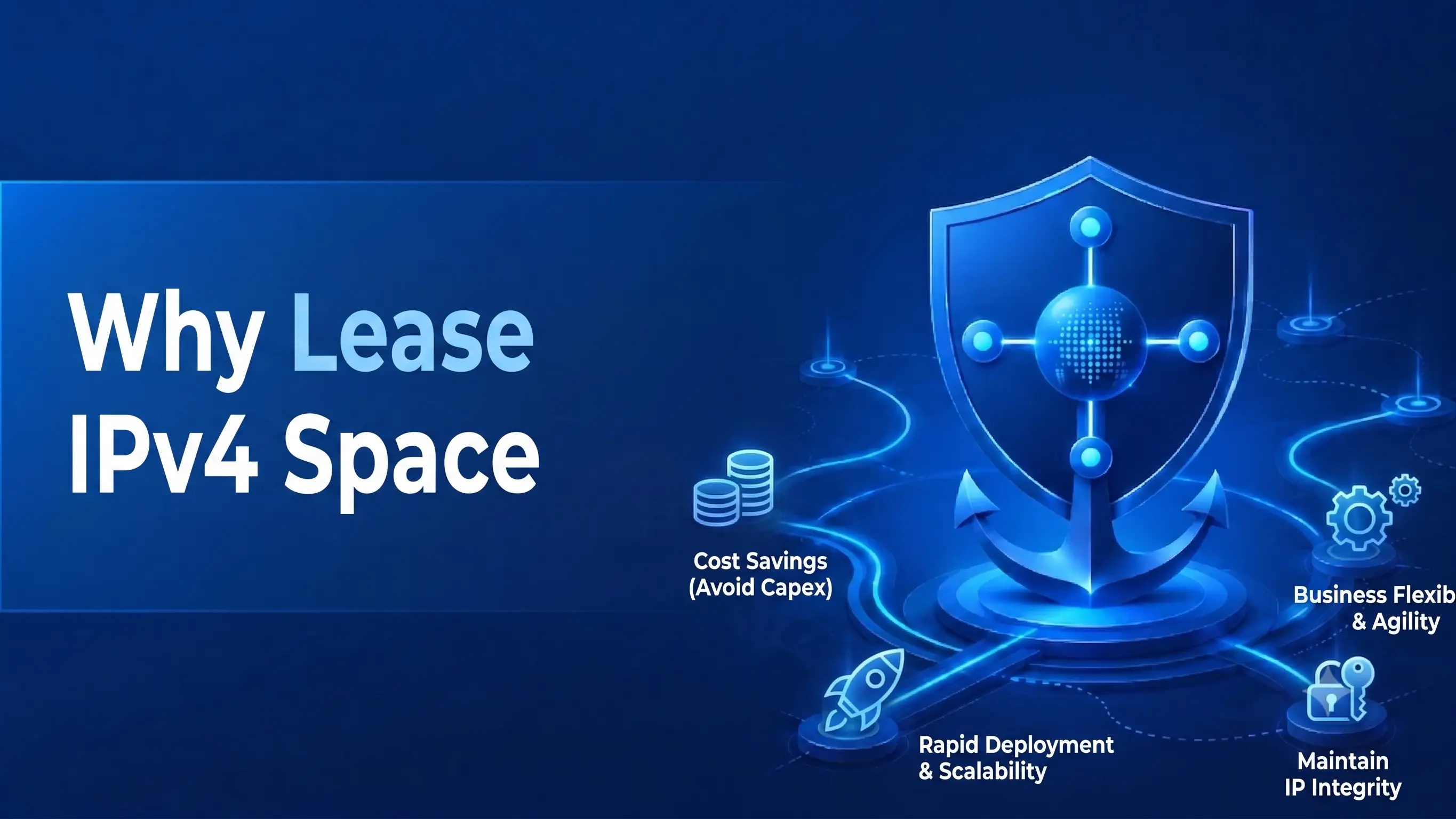
You rent a block of public addresses for use on your network. Instead of paying to acquire the block, you budget for capacity over the lease period. It can support new subscribers, hosting environments, cloud regions and migrations, as well as services you expect to run for years.
Put More of Your Budget into Growth
Address capacity earns its value when customers can use your service. Leasing lets you reserve capital for the equipment, connectivity and customer acquisition that make that happen.
- Lower the initial cash commitment. Build address costs into the operating plan rather than starting with a block purchase.
- Prepare capacity as demand grows. Discuss the next site or customer expansion with your supply partner.
- Bring launches forward. Plan supply and routing without first completing a purchase and transfer.
- Match the commercial horizon. Compare capacity and duration around the services you expect to sell.
Use the current IPv4 pricing calculator for your chosen configuration. For a per-address monthly offer, the base rental budget is address count × monthly rate × months. Compare the same capacity and period, including the service plan.
Keep Customers Connected After the First Launch
Addresses become part of APIs, DNS, VPNs and customer allowlists. An unplanned change can create work for every business connected to your service. Routing, reputation, reverse DNS, location records and renewal therefore belong in the buying decision from the start.
The IPv4 leasing deployment guide explains how to connect capacity to the applications your customers actually use.
Work Directly with LARUS
LARUS leases IPv4 from its own pool and supports the relationship around its use. Routing changes, expansion and renewal go to the team behind the supply. That gives your engineers a direct operating partner when a customer needs an answer.
Choose the Partner Who Carries the Upstream Work
A purchase does not make registry dependence disappear. A transaction-only broker can introduce supply without taking responsibility for its continued use. LARUS Continuity puts the registry-facing relationship with a specialist provider so your business can focus on serving customers.
Compare Leasing from LARUS with Buying a Block
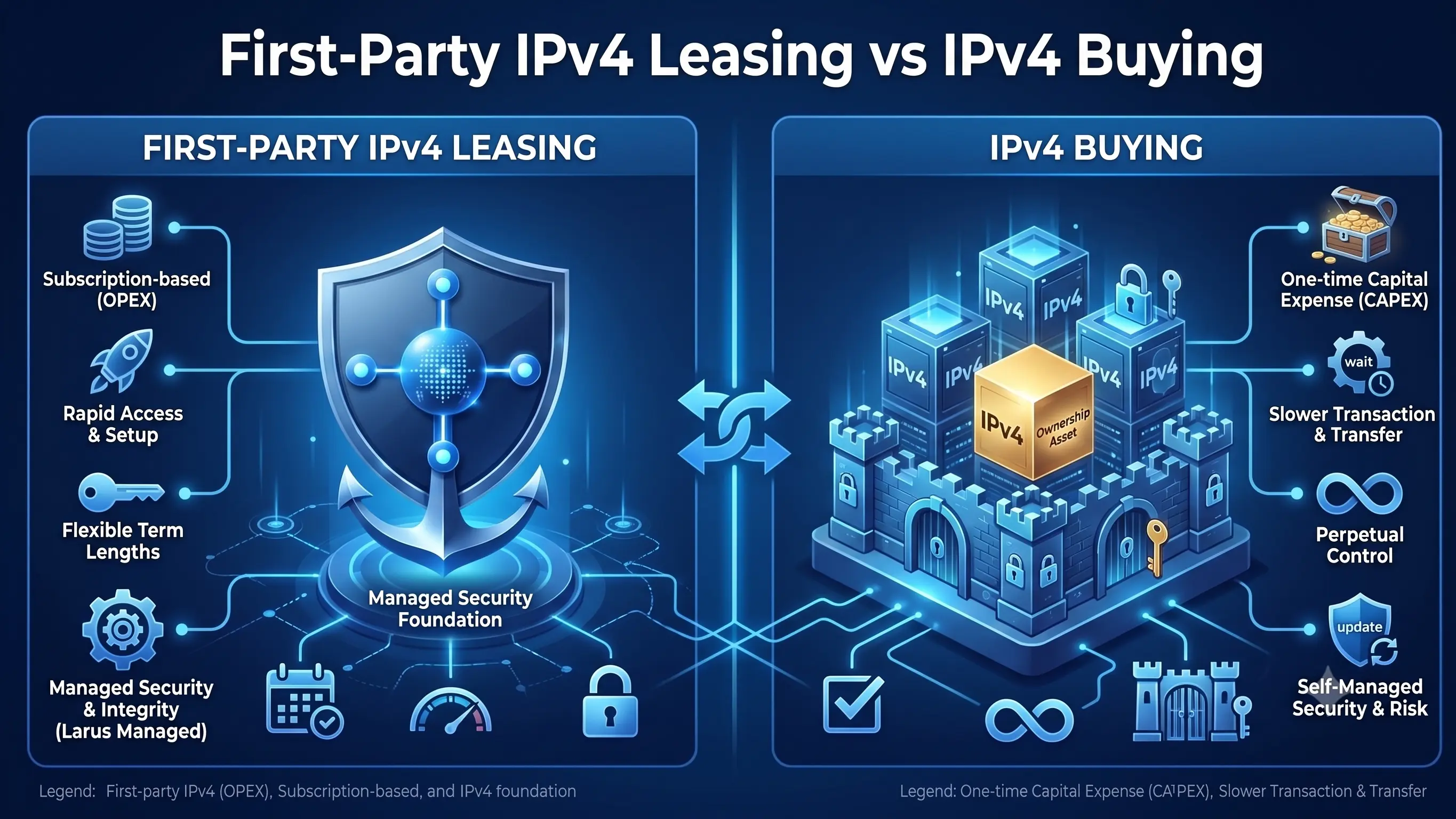
| Your decision | Lease from LARUS | Buy and hold a block |
|---|---|---|
| Initial cash | Budget for rented capacity and keep acquisition capital available. | Commit the acquisition cost before putting the block to work. |
| Expansion | Plan the next capacity increase with your supply partner. | Arrange further acquisitions as address demand grows. |
| Getting started | Coordinate the lease, authorisation and network setup. | Coordinate the purchase, transfer and network setup. |
| Registry relationship | LARUS handles the upstream relationship behind your supply. | Your organisation carries the direct holder relationship. |
| Continued use | Choose Continuity together with your address capacity. | A completed purchase still depends on the registry framework. |
Look beyond the first month's rate or the purchase price. Compare the full planning horizon, the use of your capital and the support you want behind the addresses once customers depend on them.
Which Networks Benefit from IPv4 Leasing?
ISPs need room for new subscribers. Hosting providers and data centres need addresses for customer environments. Cloud, CDN and enterprise teams need public endpoints for services and regional deployments. Leasing can support each of these while an IPv6 rollout progresses.
If the requirement is a stable identity for an end customer's business across compatible delivery providers, LARUS One is available at larus.one. Operators interested in delivering that service use the Delivery Partner programme.

Why Choose LARUS for IPv4 Continuity?
Choose the supplier for the network you intend to build, not only the block you need today. LARUS brings direct supply, operational support and a continuity structure grounded in Cloud Innovation's court-recognised shareholder position in AFRINIC and its exclusive mandate appointing LARUS.
Your team can keep capital working in the business and place the registry-facing work with a partner built for it. Lu Heng's explanation of registry risk and Continuity sets out the reasoning behind that choice.
Questions About Leasing IPv4 Space
Is leasing only for short-term projects?
No. Leasing can support both migrations and long-running services. Plan renewal, expansion and Continuity around the life of your network.
Can I route leased space on my own network?
Yes. Coordinate your origin ASN, upstream and routing authorisation with LARUS. The block-leasing guide explains the deployment steps.
Does buying remove the registry risk?
No. Acquisition does not remove the registry relationship behind the block. Choosing LARUS Continuity gives you a direct partner for that upstream work and for continued use.
How do I get a current price?
Select the block size, lease period and Continuity plan in the pricing calculator. Use that current offer to plan the next deployment.
What do I need to get started?
Bring your address count, deployment location and routing goals. Choose the Continuity plan that supports your next customers and the services they will rely on.
Keep capital working
More capacity. More room for your business.
Choose Unlimited IPv4 with LARUS Continuity and put your investment into the services your customers buy.