
Technical guide
Why Broker Chains Increase IPv4 Operational Risk
IPv4 addresses are no longer just “inventory” in a technical sense. For modern infrastructure operators—cloud providers, hosting companies, SaaS platforms, telecoms, and security networks—they are production dependencies. That means the real question is not simply where to get IPv4, but how stable the supply chain is when something goes wrong.
Explore IPv4 Continuity
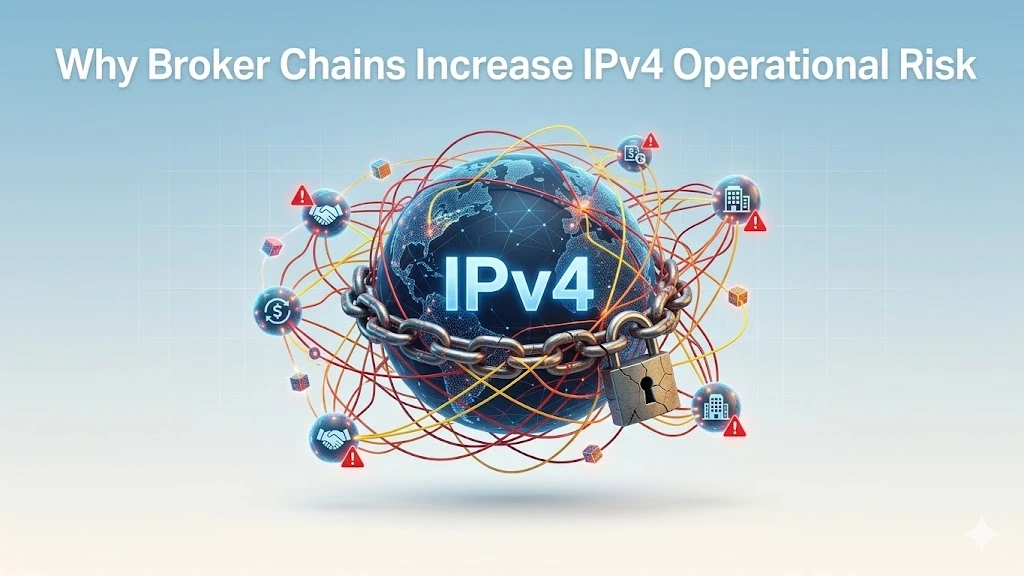
IPv4 brokers and marketplaces play a useful role in helping organisations find address space, connect with resource holders and execute transactions.
The presence of an intermediary is not inherently a problem.
Operational risk appears when a leased IPv4 service depends on multiple parties and the customer cannot clearly determine who is responsible for the registry relationship, routing authorisation, renewal or long-term continuity.
This distinction matters because an IPv4 service is rarely defined by a single relationship. Several layers may need to remain aligned:
commercial relationship → registry state → routing authorisation → operational use
A multi-party IPv4 supply structure can work well when responsibilities across those layers are clearly defined.
But when responsibility becomes fragmented or difficult to verify, additional intermediaries can create additional operational dependencies.
The risk is therefore not:
broker = unsafe
The more useful principle is:
Every dependency should have a clear purpose, a clearly accountable party and a continuity plan.
Broker Chains and IPv4 Risk: Quick Answer
Broker chains can increase IPv4 operational complexity when multiple organisations sit between the customer using the addresses and the party carrying the underlying resource relationship.
That does not mean every brokered lease is high risk.
A brokered structure can function effectively when:
- the underlying resource holder is known;
- contractual relationships are clear;
- registry-facing responsibility is defined;
- RPKI and IRR responsibilities are understood;
- renewal terms are explicit;
- abuse handling is clearly assigned; and
- continuity obligations are documented.
Risk increases when customers do not know who is responsible if one of these relationships changes.
A first-party model can reduce some of this complexity by placing more of the upstream service responsibility with the provider directly accountable to the customer.
The advantage comes from clearer accountability and fewer unnecessary dependency layers, not from centralising Internet governance or customer routing.
What Is an IPv4 Broker Chain?
An IPv4 broker chain exists when several commercial organisations participate in delivering IPv4 capacity to the final customer.
A simplified structure might look like:
resource relationship → holder → broker → leasing platform → reseller → customer
Not every transaction contains all of these layers.
Some structures may involve only a single broker between two parties. Others may involve marketplaces, resellers, technical service providers and separate resource holders.
Each organisation may perform a legitimate function.
For example:
- a broker may identify supply;
- a marketplace may facilitate matching;
- a reseller may manage customer service;
- a technical provider may support routing; and
- a resource holder may maintain the underlying registry-facing relationship.
Complexity becomes a continuity concern when the customer cannot clearly determine how these responsibilities fit together.
The Number of Parties Is Not the Same as the Level of Risk
It is tempting to conclude that more intermediaries automatically mean more risk.
That would be too simplistic.
A well-documented multi-party arrangement may be more operationally reliable than a poorly managed single-provider arrangement.
What matters is whether each dependency is:
- visible;
- necessary;
- contractually defined;
- technically understood; and
- supported by an appropriate continuity process.
An extra intermediary becomes a concern when it adds a dependency without adding corresponding clarity or resilience.
The risk is not intermediation itself. The risk is dependency without accountability.
Why IPv4 Operational Risk Exists Across Multiple Layers
IPv4 resources exist within several connected but distinct systems.
A useful way to understand the structure is to separate four layers.
| Layer | Key Question | Potential Risk |
|---|---|---|
| Commercial relationship | Who has contracted to provide the IPv4 service? | Unclear renewal, termination or service obligations |
| Registry state | Which organisation and information are recognised in the relevant registry system? | Administrative mismatch or uncertainty |
| Routing authorisation | Which ASN is authorised or expected to announce the prefix? | RPKI, IRR or routing configuration mismatch |
| Operational use | Which applications, networks and customers actually depend on the addresses? | Downtime, renumbering or broken integrations |
These layers should remain coherent, but they are not interchangeable.
A registry record does not itself announce a BGP route.
A BGP announcement does not establish every commercial right.
A ROA can authorise an ASN without defining the complete contractual structure behind the resource.
This is why operational continuity requires more than checking one database or one agreement.
Registry State Is Important, but It Is Not the Entire Network
Registry systems perform important coordination functions.
They help maintain:
- resource uniqueness;
- registration records;
- transfer information;
- RPKI-related services;
- reverse DNS; and
- other resource-management functions.
But registry state should not be confused with complete operational control.
Registry state describes an important coordination relationship. It is not identical to routing, contractual rights or the complete operational reality of a running network.
In a multi-party supply chain, the relevant risk is therefore not simply that “the registry sits at a chokepoint”.
The practical question is whether the parties responsible for registry-facing administration, routing support and customer continuity can act coherently when something changes.
Where Broker Chains Can Add Operational Complexity
Additional dependency layers can become important in several areas.
1. Renewal
The organisation contracting with the customer may not be the same organisation controlling the underlying resource relationship.
If an upstream agreement is not renewed, the downstream provider may have limited ability to preserve the same IPv4 service.
Customers should therefore understand:
- who controls renewal upstream;
- how long the underlying relationship lasts;
- whether the customer's agreement extends beyond that period; and
- what happens if the upstream resource becomes unavailable.
2. RPKI
RPKI can become operationally important when a customer needs a prefix authorised for a particular origin ASN.
In a multi-party structure, the customer should know:
- who can create or update the ROA;
- how quickly changes can be made;
- who validates the requested ASN; and
- what happens during migration.
The issue is not that routing authority should be centralised.
The customer should retain control of its network operation, while the relevant provider or resource administrator supports the required authorisation process.
3. IRR Records
Internet Routing Registry objects may also need to reflect legitimate operational use.
If several parties are involved, it should be clear who can:
- create the route object;
- change the origin ASN;
- update the relevant maintainer; and
- remove stale information when service ends.
4. Reverse DNS
Reverse DNS may be important for email, infrastructure management and other applications.
Customers should know which party has authority to manage delegation and how changes are processed.
5. Abuse Handling
Abuse reports may pass through several organisations before reaching the customer.
A good service structure should clearly define:
- where reports are received;
- who communicates with the customer;
- what remediation process applies; and
- what circumstances could affect continued service.
6. Address Reputation
IPv4 addresses can carry operational history.
Previous use may affect:
- spam filtering;
- security blocklists;
- email delivery;
- geolocation;
- fraud systems; and
- third-party network acceptance.
The customer should therefore understand who is responsible for reputation screening, abuse remediation and ongoing monitoring.
Why Customer Network Control Should Remain With the Customer
A first-party IPv4 service should not be described as centralising customer routing authority.
The customer remains the operator of its own network.
It may determine:
- its BGP policy;
- its network architecture;
- its upstream connectivity;
- its traffic engineering;
- its applications; and
- its security configuration.
The IPv4 provider may support the administrative mechanisms needed for legitimate deployment, including RPKI, IRR, reverse DNS or LOA-related processes.
But this support is different from controlling the customer's network.
Upstream registry-facing responsibility and downstream network operation should remain clearly separated.
What Makes a First-Party IPv4 Model Different?
A first-party model aims to reduce the number of organisational boundaries between the party delivering the IPv4 service and the upstream resource relationship supporting that service.
Conceptually:
Customer
→ uses and operates the IPv4 capacity within its network
First-party provider
→ carries defined upstream commercial and registry-facing responsibilities associated with the service
Registry layer
→ supports uniqueness, registration and related coordination functions
The value of this model does not come from concentrating every form of control.
It comes from making service responsibility clearer.
A first-party model can reduce unnecessary dependency layers without centralising customer routing or Internet governance.
First-Party Does Not Mean Single Point of Control
Simplifying commercial responsibility should not be confused with creating one institution that controls every layer.
A single dependency can itself become a failure point.
A resilient service should therefore focus on:
- clear accountability;
- accurate registry information;
- transparent service obligations;
- customer operational independence;
- auditable administrative processes;
- continuity planning; and
- portability where practical.
Resilience comes from understanding and managing dependencies, not simply concentrating them.
Why Continuity Matters More as an IPv4 Address Ages in Production
At the start of a lease, an IPv4 address may look like interchangeable network capacity.
Over time, that can change.
The address may become embedded in:
- customer allowlists;
- firewall rules;
- API integrations;
- banking systems;
- payment infrastructure;
- VPN configurations;
- DNS;
- security platforms;
- SaaS integrations;
- partner systems; and
- compliance documentation.
When that happens, losing the address can become much more expensive than acquiring a replacement prefix.
The real cost may come from:
- renumbering;
- customer coordination;
- security-rule changes;
- third-party approval processes;
- application downtime; and
- reputation rebuilding.
Once an IPv4 address becomes part of network identity, continuity of use can become more important than simple availability of replacement capacity.
Broker Chains and Renumbering Risk
A broker chain does not automatically cause renumbering.
But if the service depends on an upstream commercial relationship that the downstream provider does not control, changes in that relationship may eventually affect the customer.
Enterprises should therefore ask:
- What happens if the upstream holder no longer wants to supply the block?
- What happens if one agreement expires before another?
- Can the same prefix remain available at renewal?
- What continuity commitments are contractual?
- What happens if the customer changes infrastructure?
- Can the service survive a provider or network migration?
These questions are particularly important when the customer expects to build long-term dependencies around the same IPv4 identity.
Continuity Should Not Mean Permanent Provider Lock-In
A strong continuity model should avoid unnecessary coupling between the customer's IPv4 identity and unrelated infrastructure.
If a business changes:
- data centre;
- cloud environment;
- hosting provider;
- upstream network;
- routing architecture; or
- other infrastructure components;
those changes should not automatically require a change of IP identity where continuity can technically and contractually be preserved.
This is why provider-neutral continuity and portability can be important design goals.
Brokered Leasing vs First-Party IPv4 Service
| Consideration | Brokered / Multi-Party Model | First-Party IPv4 Model |
|---|---|---|
| Market discovery | Often a core strength | Secondary to service delivery |
| Number of commercial parties | May involve several parties | Designed to reduce unnecessary layers |
| Registry-facing responsibility | Depends on the underlying structure | Designed to remain clearer with the service provider |
| Customer routing control | Customer | Customer |
| RPKI / IRR support | Depends on holder and intermediary structure | Can be incorporated into ongoing service support |
| Renewal responsibility | May depend on several relationships | More directly associated with the service provider |
| Continuity | Must be clarified contractually | Can be designed as part of the ongoing service |
| Best fit | Market access, matching and flexible sourcing | Long-term service, accountability and continuity |
Neither structure is universally superior.
The appropriate model depends on what the customer actually needs.
When a Brokered IPv4 Model Can Make Sense
A brokered or multi-party model may be appropriate when an organisation values:
- access to broader market supply;
- transaction expertise;
- short-term flexibility;
- specialised block requirements;
- price discovery; or
- one-time transaction support.
The important requirement is transparency.
The customer should be able to understand which party is responsible for each material part of the service.
When a First-Party IPv4 Model Can Make More Sense
A first-party model may be more suitable when the customer requires:
- long-term IPv4 use;
- stable service responsibility;
- clearer upstream accountability;
- RPKI and IRR support;
- reverse DNS support;
- reputation management;
- renewal continuity; and
- reduced risk of avoidable renumbering.
For these organisations, the service relationship becomes more important than simple access to available IPv4 inventory.
Why LARUS Uses a First-Party IPv4 Model
LARUS approaches IPv4 leasing as an ongoing infrastructure service, rather than only as a transaction between a holder and an end user.
The model is designed around:
Clear Upstream Responsibility
Customers should understand which organisation is accountable for delivering the IPv4 service they are using.
Customer Operational Independence
Customers retain control of their networks, routing policy, applications and infrastructure.
Registry-Facing Support
The service provider carries defined upstream responsibilities associated with the supplied IPv4 capacity.
Continuity Planning
Renewal, infrastructure migration and other changes should be considered before they become emergency events.
Reduced Unnecessary Dependency
Additional organisational or contractual layers should exist only when they provide useful capability.
Provider-Neutral Continuity Where Practical
Where IPv4 becomes part of long-term network identity, unnecessary infrastructure lock-in and avoidable renumbering should be reduced where possible.
Learn more about LARUS IPv4 Leasing Continuity Assurance .
What Enterprises Should Ask Before Leasing IPv4
Whether working with a broker, marketplace, reseller or first-party provider, enterprises should ask:
- Who is my direct contractual counterparty?
- Who carries the underlying registry-facing relationship?
- How many organisations sit between me and that relationship?
- Who can update RPKI?
- Who can update IRR records?
- Who manages reverse DNS?
- Who handles abuse reports?
- Who evaluates address reputation?
- What happens when the lease renews?
- What happens if an upstream party ends its relationship?
- Can the same prefix remain available during infrastructure migration?
- Who is accountable for continuity?
The answers to these questions often reveal more about operational risk than headline price alone.
Price Is Not a Complete Measure of IPv4 Risk
A lower-priced IPv4 service is not automatically riskier.
A higher-priced service is not automatically more resilient.
Price should be evaluated alongside:
- contract structure;
- resource provenance;
- registry-facing responsibility;
- routing support;
- address reputation;
- renewal terms;
- portability; and
- continuity obligations.
Price tells you what IPv4 capacity costs. Service structure tells you what happens when conditions change.
Frequently Asked Questions
Are IPv4 brokers risky?
Not inherently. Brokers can provide valuable market discovery, matching and transaction support. Risk increases when the resulting service structure makes responsibility for registry administration, routing support, renewal or continuity unclear.
Why can multiple IPv4 intermediaries create operational risk?
Multiple parties can create additional dependencies. If those dependencies are poorly documented, a customer may have difficulty determining who can make registry or routing-related changes, who controls renewal or who is accountable when an upstream relationship fails.
Does a first-party IPv4 provider control customer routing?
No. The customer should retain control of its own network and routing policy. The provider may support administrative functions such as RPKI, IRR or reverse DNS where required by the service.
Is centralising routing authority safer?
Not necessarily. Resilience comes from clear responsibility and well-designed continuity, not from assuming one organisation should control every layer.
What is registry-facing responsibility?
Registry-facing responsibility refers to the administrative relationship and processes associated with the resource's registry state and related registry-supported functions.
Why does renewal continuity matter?
IPv4 addresses can become embedded in customer allowlists, APIs, firewalls, banking systems, security policies and other external integrations. Unexpected loss of the same prefix can therefore create a costly renumbering and business-continuity event.
Is a first-party IPv4 model always better than brokered leasing?
No. Brokered models can be appropriate for market access, transaction flexibility and specialised sourcing. First-party service may be more appropriate where long-term continuity and clear service accountability are priorities.
What should an enterprise check before leasing IPv4?
Enterprises should review the underlying resource structure, contractual parties, registry-facing responsibility, RPKI and IRR support, reverse DNS, address reputation, renewal terms, portability and continuity obligations.
Conclusion
Broker chains do not automatically make IPv4 services unsafe.
Brokers, marketplaces and other intermediaries can provide real value through market discovery, transaction execution and flexible sourcing.
The risk appears when multiple dependencies exist without clear responsibility.
IPv4 continuity depends on several separate but connected layers:
commercial relationship + registry state + routing authorisation + operational use
These layers should remain aligned without being collapsed into one source of control.
A first-party model can reduce operational complexity by reducing unnecessary organisational boundaries and placing more upstream service responsibility with the provider directly accountable to the customer.
But the customer should continue to control its own network operations.
The objective is not centralised governance.
The objective is clear accountability, accurate coordination, operational independence and continuity when one dependency changes.
Organisations that depend on stable IPv4 identity can explore LARUS IPv4 Leasing Continuity Assurance .
For an overview of different leasing structures, read IP Leasing: How IPv4 Leasing Works, Models, Costs & Benefits .
For a deeper comparison between transaction intermediaries and direct service providers, see IPv4 Broker vs First-Party IP Leasing Provider: What’s the Difference? .
Keep your network moving
Turn the next answer into your next network move.
Build with Unlimited IPv4 and explore LARUS Continuity for the network your customers depend on.