
Technical guide
IPv4 Total Cost of Ownership in 2026
Plan the IPv4 capacity, engineering and continuity your next deployment needs—so your team can grow without repeatedly paying to renumber customer services.
Plan your IPv4 continuityYour IPv4 budget should help you launch the next service, serve more customers and keep production running. The quoted price per IP is the starting point. The real cost also includes the engineering needed to put those addresses to work—and the disruption of changing them once customers depend on them.
For an ISP, hosting business or cloud platform, a useful budget brings five costs into view:
IPv4 TCO = capacity + deployment + operations + change + continuity.
This guide helps your procurement and network teams compare those costs together. Start with the capacity you need, account for the work behind it, and protect the services that would be expensive to renumber.
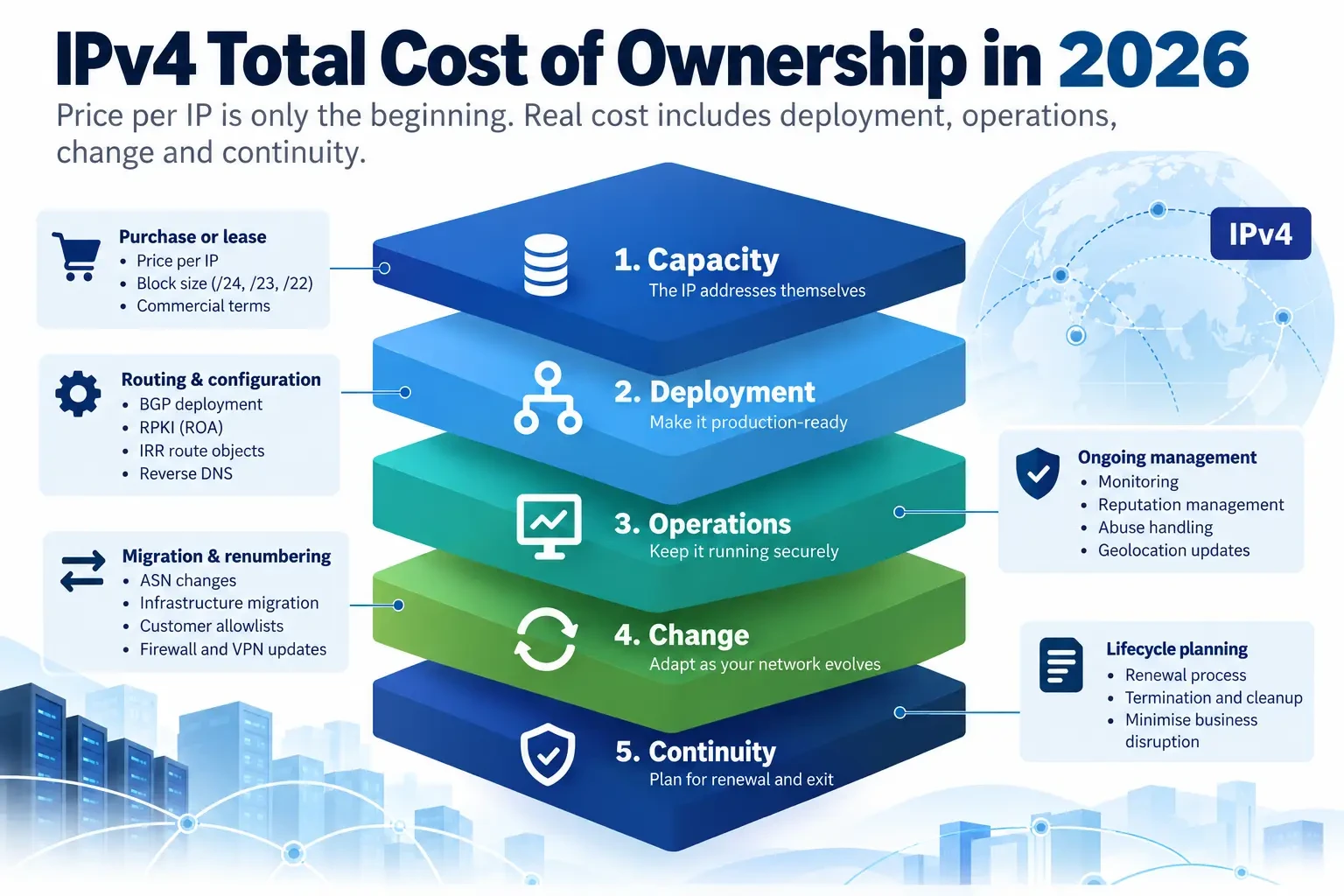
What is IPv4 total cost of ownership?
IPv4 total cost of ownership, or IPv4 TCO, combines the cost of obtaining, deploying, operating, changing and eventually replacing or retiring IPv4 capacity. It puts address costs beside the time your people spend on routing, reputation, monitoring and customer coordination.
Your network may already handle BGP, RPKI, IRR and monitoring internally. Those capabilities belong in the comparison: engineering time is still a cost, even when it does not appear on a supplier invoice. Provider support can free that time for customer deployments and growth.
An IPv4 TCO framework for procurement teams
Use the same operating period and capacity for every offer. For each row, record the direct charge, internal engineering time and expected frequency of change. That gives finance and network operations a shared view of what the deployment will take.
| Cost layer | What to budget | Often visible in the first quote? |
|---|---|---|
| IPv4 capacity | Lease or acquisition cost for the required block and term | Yes |
| BGP and routing | Configuration, upstream coordination, failover and testing | Sometimes |
| RPKI | ROA creation, maintenance and origin-ASN changes | Sometimes |
| IRR | Route objects, maintainer access and routing-filter coordination | Sometimes |
| Reverse DNS | PTR management or delegation | Sometimes |
| IP reputation | Review, monitoring, remediation and support time | Often not |
| Geolocation | Database checks and correction requests | Often not |
| Internal engineering | Network, security, DevOps and operations time | Usually not |
| Monitoring | Routing visibility, reputation, abuse and availability oversight | Sometimes |
| Renumbering | Customer allowlists, APIs, VPNs and firewall changes | Usually not |
| Migration | ASN, transit, data-centre and infrastructure changes | Usually not |
| Renewal | The next service term and the cost of switching | Partly |
| Exit work | Workload migration, route withdrawal and technical cleanup | Usually not |
| Continuity | Protecting the network your customers rely on, including registry-layer exposure | Often not |
What 2026 IPv4 market data tells you about cost
IPv4 continues to trade actively. Mustafa Akdeniz's H1 2026 market analysis reports 596 completed transactions covering 5,016,064 IPv4 addresses, using IPv4Center marketplace transactions and RIR transfer records. In that dataset, 182 transactions involved /24 blocks—about 30.5% of deals.
The LARUS IPv4 liquidity guide explores what that activity means for operators. Transaction data helps you understand the market; your operating budget also needs the deployment, change and continuity costs below. For current rates, use IPv4 pricing and market statistics.
1. Match capacity to the customers you plan to serve
A /24 contains 256 IPv4 addresses, a /23 contains 512 and a /22 contains 1,024. Translate that capacity into customer assignments, infrastructure use and the next expansion, then compare equivalent blocks and terms.
Small, repeated purchases of capacity can repeat the same deployment work. Planning ahead lets your team bring the next rack, region or service online with fewer rushed changes. Use the /24-to-/22 capacity planning guide to map growth before comparing offers.
2. Budget for a prefix that is ready to carry traffic
BGP deployment
Your prefix needs an origin ASN and a route through the networks carrying your traffic. BGP exchanges reachability between autonomous systems; RFC 4271 defines the protocol.
Include router configuration, upstream coordination, prefix filtering, route testing, traffic engineering, failover and monitoring. These tasks consume engineering time rather than a simple per-IP charge. Getting them ready together helps your customers reach the new service when it launches.
RPKI and Route Origin Authorizations
Keep the intended BGP origin consistent with its Route Origin Authorization. A ROA authorizes an AS to originate specified prefixes; RFC 9582 defines the current ROA profile. It establishes route-origin authorization, not ownership.
Plan who creates and updates the ROA, which ASN and prefix lengths it permits, and how changes will follow a migration. A mismatch can produce an Invalid route-origin state, which receiving networks handle according to their validation policies. Correct records help keep routing changes from becoming customer reachability problems. See the RPKI guide.
IRR route objects
An IPv4 IRR route object pairs a prefix with its origin ASN. Some upstream networks use IRR data to build routing filters, so include route-object maintenance, maintainer access and filter-update coordination in your deployment plan.
The object does not create a BGP route itself. Keeping it aligned with the live announcement avoids extra troubleshooting when your network changes. See what an IRR route object does and ARIN's IRR administration guide.
3. Make the addresses work for your applications
IP reputation
Address history can affect email, security and fraud systems. Assess the reputation signals your workload actually encounters, then budget for investigation, blocklist review, remediation and customer support. Reputation changes over time and across platforms; a useful review tells your team what to resolve before launch. The IP address reputation guide explains how to read those signals.
Reverse DNS
PTR records matter for email, hosting, diagnostics and operational tools. Establish who manages reverse DNS, whether delegation is needed, how sub-prefixes are handled and how your team will make changes. A clear workflow makes deployment and support easier.
Geolocation
A prefix may retain earlier location information in third-party databases. Where location affects payments, content, fraud checks or access controls, include verification and correction requests before launch. Check the databases used by your applications: an update in one does not update every other service.
4. Count the operating time behind each deployment
Network engineering, DevOps, security, procurement, finance and support all contribute to IPv4 operations. Include design, documentation, routing changes, testing and coordination—not just the first invoice.
Once traffic is flowing, monitor BGP visibility, RPKI state, address assignments, reputation, abuse and application availability. Decide which work your team performs and which work your provider delivers, so a routine update has a clear owner and a dependable path to completion.
5. Price the change your customers would have to make
An address can start as a configuration value and become embedded in customer allowlists, APIs, VPNs, firewalls, payment systems, partner networks and monitoring tools. Your router change may take minutes; coordinating everyone else's changes can take much longer.
Ask what would need updating if you replaced the prefix next year. Count the affected customers, external systems, change windows and engineering teams. This is the business cost of renumbering, and it belongs in the budget before your new service depends on the addresses.
Lu Heng's analysis of network identity explains why established addresses acquire value through the relationships built around them. For an operator, protecting those relationships means protecting revenue and keeping growth from turning into repeated migration work.
6. Plan growth, renewal and exit as part of the lifecycle
A new data centre, transit provider, origin ASN or application platform can require changes to BGP, ROAs, IRR and reverse DNS. Map those dependencies in advance so your infrastructure can evolve while customer-facing services remain dependable.
At renewal, compare the next service term with the full cost of switching. Addresses embedded in customer systems deserve a continuity plan that reflects their business importance.
If you retire a deployment, include workload migration, BGP withdrawal, ROA and IRR updates, reverse-DNS cleanup, customer communication and monitoring after the move. The IPv4 lease termination guide provides a practical operating checklist.
Buying versus leasing: include the risk behind the registry record
Comparing a purchase price with monthly rent leaves out a crucial cost: who carries registry-layer exposure when your production network depends on the addresses?
Direct holding keeps that exposure with your operating company. A broker can arrange a transaction without taking responsibility for the underlying continuity problem. LARUS's first-party model puts the registry interface upstream with LARUS, so your team can focus on delivering service.
Lu Heng's registry-risk analysis explains that distinction. Cloud Innovation's statutory shareholder rights and its authorization of LARUS underpin that continuity position. The published court record explains the foundation behind a first-party relationship built to protect your network continuity.
Your comparison should therefore include capacity, financing, operations, migration and continuity. Keep capital available for the network and customers you are building, with LARUS carrying the first-party address relationship. The IPv4 leasing guide explains the next operating steps.
A practical comparison for a growing hosting business
Imagine a hosting business planning /22-scale capacity. One offer has a lower unit rate but leaves routing updates, reputation work and every migration task with its engineers. Another provides the operating support those engineers would otherwise deliver.
Compare the full working period: the capacity charge, expected engineering hours, repeated changes and the cost of interrupting customer services. Include the tools and automation you already have. Then ask which arrangement leaves your team more time to launch the next customer.
A spreadsheet that ends at the unit rate cannot answer that question. A lifecycle budget can.
Include IPv6 in your capacity plan
Use IPv6 where your workloads and customers can benefit from it, while keeping the IPv4 compatibility their existing services need. That helps you plan new capacity around real usage. IANA's number-resource overview describes the coordination of IPv4, IPv6 and AS numbers.
Build the two protocols into the same growth plan. Your customer needs a reachable service, and your team needs a practical way to deliver it.
Build the next deployment around LARUS Continuity
LARUS brings Unlimited IPv4 and a first-party continuity relationship to the network your customers depend on. You keep control of your applications and network design, while building address supply and continuity into one commercial decision.
Bring your capacity forecast, routing model and the services you need to protect. Compare the LARUS Continuity plans with the engineering, migration and customer disruption they address. Your IPv4 budget can then support a growing business, instead of repeatedly paying to rebuild what already works.
IPv4 TCO questions
Is price per IP still important?
Yes. It is the capacity line in your budget. Add deployment, operations, change and continuity to see what the addresses will cost your business throughout their use.
Why can a cheaper block cost more to operate?
Reputation work, engineering time, repeated routing changes and customer renumbering can outweigh a smaller capacity bill. Compare equivalent workloads and responsibilities to identify the better commercial outcome.
Does a higher price prove better service?
Judge the service by the work it takes off your team and the continuity it provides. Match routing, reputation, support and change responsibilities to your actual deployment.
Why include RPKI and IRR?
They support routing readiness and need to stay aligned when your origin ASN or upstream relationships change. Budgeting for those updates helps keep new deployments and migrations moving.
What is the biggest hidden IPv4 cost?
For a network whose addresses are already embedded in customer systems, renumbering can become a business-wide project. Engineering, customer coordination and lost operating time are costs that a unit-price quote rarely captures.
Should an operator buy or lease IPv4?
Compare more than upfront cash and rent. Direct holding also puts the registry relationship inside your operating company. LARUS Continuity gives you a first-party leasing path built around keeping the customer network running, with capital available for growth.
Can IPv6 reduce the need for additional IPv4?
Yes, where applications and customers support it. Plan IPv6 adoption alongside the IPv4 compatibility your revenue-producing services still require.
Keep growth moving
Put your budget behind a network that keeps serving customers.
Bring your capacity forecast, routing needs and customer dependencies. Build with Unlimited IPv4 and choose the LARUS Continuity plan that supports your next deployment.