
Technical guide
Beyond Brokers: Why First-Party IPv4 Leasing Reduces Registry Exposure
Discover why first-party IPv4 leasing reduces registry exposure compared to traditional brokers. Learn how a continuity-focused model improves compliance, minimizes transfer risk, and ensures stable IPv4 infrastructure for modern enterprises.
Explore IPv4 Continuity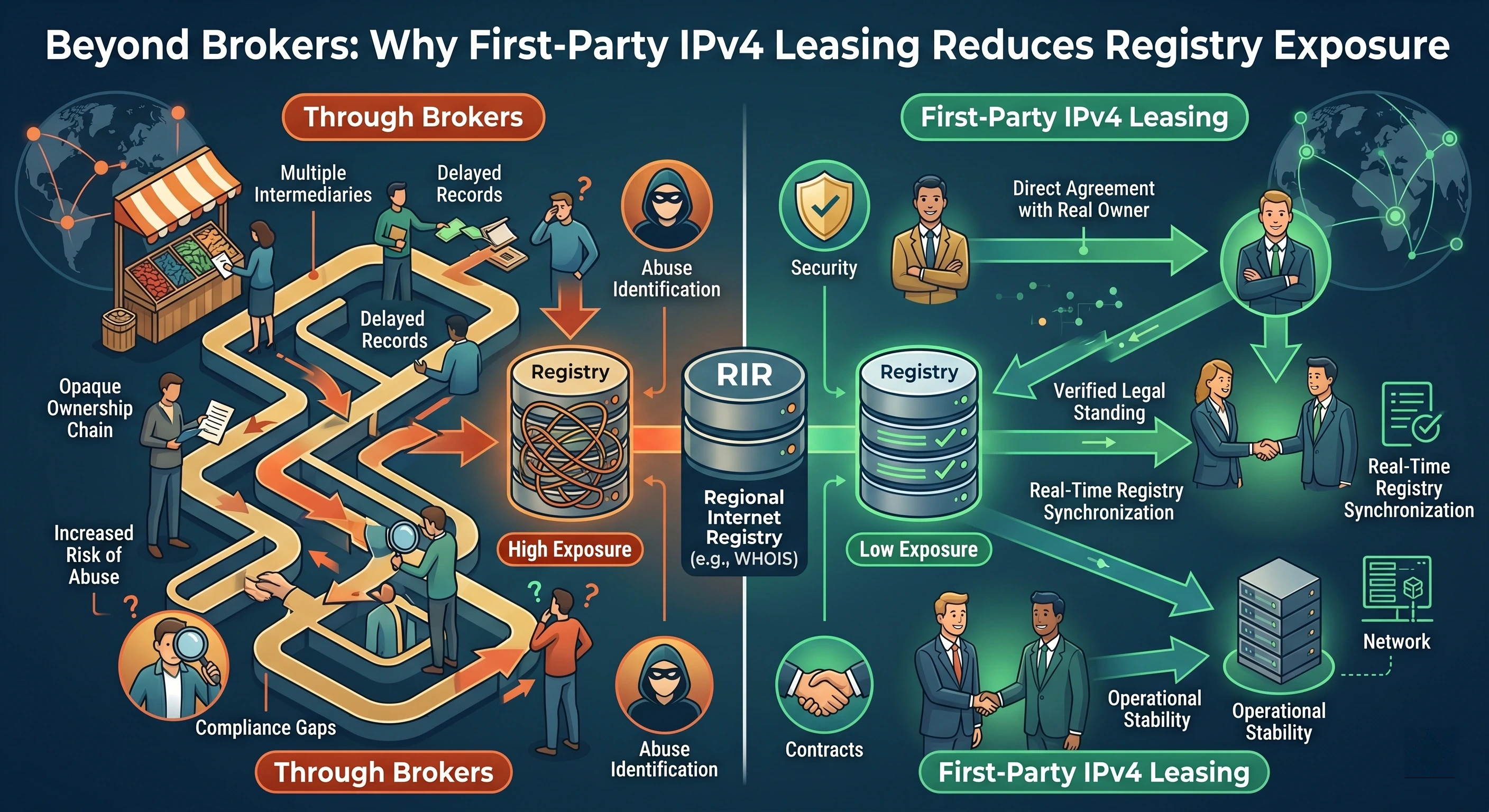

Why First-Party IPv4 Leasing Reduces Registry Risk Exposure
IPv4 leasing is often evaluated through a simple commercial lens: price, block size, availability and contract duration.
For enterprise networks, however, the more important question may be what sits behind the lease.
Who maintains the registry-facing relationship? Who can update routing-related records? Who is responsible if an upstream relationship changes? And who is accountable for continuity when the customer has become operationally dependent on the same IPv4 addresses?
These questions matter because IPv4 exists across several different layers:
commercial relationship → registry state → routing authorization → operational use
Those layers usually need to remain aligned, but they are not the same thing.
A first-party IPv4 leasing model can reduce certain forms of registry-layer exposure by making the upstream resource relationship and continuity responsibility clearer.
The benefit does not come from centralizing Internet governance. It comes from clearer accountability, fewer unnecessary dependency layers, and a better-defined continuity model.
First-Party IPv4 Leasing: Quick Answer
First-party IPv4 leasing can reduce registry risk exposure when the provider directly carries the registry-facing responsibility associated with the supplied resources while the customer focuses on operational use.
This does not mean leasing removes all risk.
It means risk can be allocated differently.
In a well-structured first-party model:
- the customer uses the IPv4 resources operationally;
- the provider manages the upstream registry-facing relationship;
- commercial accountability is clearer;
- routing and authorization responsibilities are defined;
- renewal expectations are explicit;
- unnecessary intermediary dependencies can be reduced; and
- continuity becomes part of the service design rather than an afterthought.
The objective is not to claim that first-party leasing is universally safer than direct ownership or every other leasing structure.
The objective is to make one question easier to answer:
Who is responsible for preserving usable IPv4 service when something upstream changes?
What Is Registry Risk Exposure?
Registry risk exposure is the dependency created when the continued administration, transferability or supporting registry functions of an IPv4 resource depend on institutional processes outside the operator's direct network control.
Regional Internet Registries perform important coordination functions.
Those functions can include:
registration, transfer processing, RPKI services, reverse DNS, organization records and other resource-management functions.
These services help preserve uniqueness and coordination across independently operated networks.
But a registry record is not the same thing as a running network.
Registry state describes an important coordination relationship. It does not by itself represent the complete commercial, routing or operational reality of an IPv4 resource.
Registry risk therefore does not mean registries are unnecessary or inherently unsafe.
It means organizations should understand which important operational dependencies sit outside the network itself and who carries responsibility for those dependencies.
Direct Ownership Does Not Eliminate Registry Exposure
One common assumption is that purchasing IPv4 completely removes the dependency created by leasing.
Direct acquisition can provide meaningful commercial and administrative control.
For organizations with stable long-term requirements, sufficient capital and appropriate internal expertise, purchasing may be entirely reasonable.
But direct holding does not make the registry layer disappear.
A directly registered organization may still need to maintain:
accurate registry records, relevant agreements, corporate documentation, RPKI, reverse DNS, transfer eligibility and other registry-supported functions.
It may also need to ensure that:
BGP announcements, ROAs, IRR records and operational routing arrangements remain aligned.
Direct ownership therefore changes where responsibility sits.
It does not create complete independence from the coordination systems surrounding globally routable IPv4.
For more context, see Why Enterprises Are Reconsidering Direct IPv4 Purchases .
Leasing Does Not Automatically Remove Risk Either
The opposite assumption is also incomplete.
Leasing IPv4 does not automatically make registry, routing or continuity risk disappear.
A customer may still depend on:
the underlying resource holder, the lease provider, registry administration, routing authorization, renewal terms and upstream network relationships.
A useful lease structure should therefore answer questions such as:
Who maintains the registry-facing relationship? Who manages ROAs? Who supports IRR changes? Who handles reverse DNS? What happens at renewal? What happens if one commercial relationship ends? And what happens if the customer needs to keep the same network identity?
The relevant comparison is therefore not simply:
ownership versus leasing
It is:
how responsibility, dependency and continuity are structured in each model.
Why Multiple Intermediary Layers Can Matter
IPv4 markets can involve resource holders, brokers, marketplaces, leasing platforms, network providers and end users.
Intermediation is not inherently problematic.
Brokers and marketplaces can perform useful functions, including:
discovery, matching, pricing assistance, transaction execution and administrative support.
Risk can increase, however, when additional layers make responsibility unclear.
For example, a customer may not know:
who ultimately carries the registry-facing relationship, who can modify routing authorizations, who handles renewal, or who is accountable if the resource becomes unavailable.
The problem is therefore not the existence of an intermediary.
The problem is unclear dependency and unclear accountability.
Every additional dependency should have a clear function, a clear owner and a clear continuity plan.
What Makes a First-Party IPv4 Model Different?
A first-party model reduces the distance between the provider responsible for the service and the upstream IPv4 resource relationship.
Instead of the customer depending on a long chain of unrelated commercial relationships, the service provider carries a more direct responsibility for the resources used to deliver the service.
Conceptually, the structure can be viewed as:
Customer
→ uses the IPv4 resources operationally
First-party provider
→ maintains the upstream resource and registry-facing responsibility associated with the service
This separation can allow the customer to focus on:
routing, applications, infrastructure and business operations, while the provider carries more of the upstream administrative responsibility.
The objective is not to centralize:
Internet governance, BGP routing, customer network control or universal registry authority.
The objective is to make responsibility for the supplied IPv4 service clearer.
Clear Accountability Matters More Than Centralized Governance
A common mistake is to assume that continuity improves simply because control is centralized.
That is not necessarily true.
A centralized dependency can itself become a failure point.
What matters more is whether responsibilities are:
transparent, understandable, auditable and supported by a continuity plan.
A strong IPv4 service model should therefore make clear:
who holds each responsibility, how failures are handled, what changes require customer action, and what happens if the upstream environment changes.
The benefit of first-party service comes from clearer risk allocation, not from the idea that one institution should control every layer.
Fewer Registry Events Do Not Automatically Mean Lower Risk
It may be operationally useful to avoid unnecessary transfers or administrative changes.
Fewer transitions can reduce complexity.
But the number of historical registry events is not itself a reliable measure of risk.
A prefix that has never changed registrants may still have:
outdated organization records, incorrect contacts, stale ROAs, old IRR objects or unresolved corporate documentation.
By contrast, a recently transferred prefix may have:
accurate registry data, clear documentation, correct RPKI authorization and well-maintained routing records.
A better principle is:
Reducing unnecessary registry transitions can simplify administration, but continuity depends more fundamentally on accurate records, clear responsibility and an executable operational model.
Why a Single Resource Origin Is Not Automatically Safer
Another oversimplification is the idea that a single resource origin or a single provider is inherently safer than every distributed structure.
Concentration can simplify administration.
But concentration can also create dependency.
The real question is whether the service design can continue functioning when:
systems fail, corporate relationships change, infrastructure migrates or registry-facing processes are disrupted.
A first-party service is valuable when it reduces unnecessary organizational complexity while still maintaining clear continuity responsibilities.
The advantage comes from:
simpler accountability and fewer unnecessary dependency layers, not from assuming that centralization itself guarantees resilience.
Registry State, Routing Authorization and Operational Use Are Different
IPv4 continuity becomes easier to understand when these layers are separated.
| Layer | Main Question |
|---|---|
| Commercial relationship | What contractual rights does the customer have to use the IPv4 resource? |
| Registry state | Which organization is recognized in the relevant registry system? |
| Routing authorization | Which ASN is authorized or expected to originate the prefix? |
| Operational use | Which network and business systems actually depend on the addresses? |
No single row in this table defines the entire reality of the resource.
A registry record does not announce a route.
A BGP route does not prove every contractual right.
A ROA authorizes routing behavior but does not define the complete commercial relationship.
Operational resilience depends on keeping these layers sufficiently aligned.
Why Accurate Registry and Routing Records Matter
Registry exposure should not be reduced to a philosophical debate about institutional power.
It has practical consequences.
Poorly maintained resource information can create friction during:
routing changes, transfers, RPKI updates, reverse DNS administration, corporate restructuring and incident response.
Enterprises should therefore understand:
which organization is recorded against the resource, which contacts are current, what ROAs exist, what IRR objects exist, and which ASN is expected to originate the prefix.
Clear responsibility for maintaining those records is one of the practical advantages a structured first-party model can provide.
IPv4 Reputation Is Another Continuity Layer
Registry state is only part of the operational picture.
IPv4 addresses can also carry historical reputation.
A resource previously associated with spam, malware or abuse may face:
blocklists, geolocation inconsistencies, delivery problems or additional network scrutiny.
That means continuity requires attention not only to who can use an address, but also to whether the address remains practically usable.
A first-party provider should therefore treat:
reputation monitoring, abuse handling and remediation as part of the operational lifecycle, rather than assuming that a valid registry record alone guarantees service quality.
When IPv4 Becomes Part of Network Identity
Registry risk becomes especially important when a business depends on keeping the same addresses.
IPv4 can become embedded in:
customer allowlists, firewall rules, VPN configurations, banking systems, APIs, payment systems, SaaS integrations, DNS records, compliance documentation and partner configurations.
At that point, replacing the prefix may no longer be a simple network change.
It can become a business-continuity event.
The operational value of an IPv4 address may eventually come less from the address itself and more from the external systems that have learned to trust it.
This is why continuity-oriented IPv4 services need to consider not only address availability, but also the cost of forced renumbering.
Continuity Should Avoid Unnecessary Provider Lock-In
Continuity should not mean replacing one dependency with another permanent dependency.
If an IPv4 address becomes part of an organization's long-term network identity, the customer should understand what happens if:
the infrastructure provider changes, the routing provider changes, the commercial relationship changes or the underlying service architecture evolves.
A stronger continuity model should make the operational identity as portable as the service structure reasonably allows.
The objective is to reduce avoidable renumbering and provider lock-in while preserving accurate registry and routing coordination.
First-Party Leasing vs Brokered Leasing
The distinction between first-party and brokered models is primarily about service structure, not about whether one category is inherently good or bad.
| Consideration | Brokered / Intermediated Model | First-Party Model |
|---|---|---|
| Primary value | Discovery, matching and transaction execution | Ongoing service delivery and continuity |
| Dependency layers | May involve multiple parties | Can reduce unnecessary commercial layers |
| Registry-facing responsibility | Depends on structure and counterparties | Designed to remain clearer with the provider |
| Continuity accountability | Must be clarified contractually | Can be built into the service model |
| Best use case | Market access and transactional flexibility | Longer-term operational continuity |
Brokered structures can be appropriate.
First-party structures can also be appropriate.
The decision should depend on what the customer requires from the relationship.
What Enterprises Should Ask Before Leasing IPv4
Enterprises evaluating an IPv4 provider should look beyond headline price.
Important questions include:
Who carries the registry-facing relationship? How many contractual layers sit between the customer and the supplied resource? Who controls or updates RPKI? Who manages IRR changes? Who handles reverse DNS? What happens at renewal? What happens if an upstream dependency fails? Can the customer retain the same address identity if infrastructure changes? How is abuse handled? And who is accountable for continuity?
The answers provide a better picture of operational risk than lease price alone.
Why Price Alone Is Not a Measure of Continuity Risk
Two IPv4 leases can have similar prices while having very different dependency structures.
A lower price does not automatically mean higher risk.
A higher price does not automatically guarantee resilience.
Continuity depends on the underlying service design.
Enterprises should therefore evaluate:
contractual clarity, registry-facing responsibility, routing support, provider structure, operational history and continuity obligations.
Price tells you what IPv4 capacity costs. Service structure tells you what happens when something changes.
A More Resilient IPv4 Leasing Model
A resilience-oriented IPv4 service should be designed around several principles.
Clear Responsibility
Every material dependency should have an identifiable accountable party.
Accurate Coordination
Registry records, RPKI, IRR and operational routing information should remain aligned with legitimate network use.
Continuity Planning
The service should address what happens during renewal, provider change, infrastructure migration and upstream disruption.
Limited Dependency
Unnecessary contractual or organizational layers should be reduced where they do not add value.
Operational Portability
Where an IPv4 address has become part of long-term network identity, service design should reduce unnecessary renumbering and lock-in.
Auditable Registry Functions
Where registry-layer services become critical operational dependencies, continuity is stronger when those functions are transparent, auditable and not dependent on an unexplained single point of institutional failure.
How LARUS Approaches First-Party IPv4 Continuity
LARUS approaches IPv4 leasing as an infrastructure continuity problem rather than only a temporary address-supply transaction.
The first-party model is designed to keep the registry-facing relationship upstream while allowing the customer to focus on operational deployment.
The goal is not to control the customer's routing or centralize Internet governance.
The goal is to make responsibility for the supplied IPv4 capacity clearer and to reduce unnecessary dependency layers.
For organizations where address stability matters, see LARUS IPv4 Leasing Continuity Assurance .
For a broader explanation of leasing models, read IP Leasing: How IPv4 Leasing Works, Models, Costs & Benefits .
Frequently Asked Questions
What is registry risk in IPv4 leasing?
Registry risk refers to dependencies created by the administrative systems and institutional processes supporting an IPv4 resource, including registration, transferability, RPKI, reverse DNS and related functions.
Does direct IPv4 ownership remove registry risk?
No. Direct holding can provide significant control, but the holder still participates in registry and routing coordination systems.
Does IPv4 leasing remove registry risk?
No. Leasing reallocates responsibilities. The important question is which party carries the registry-facing relationship and who is accountable for continuity.
Why can a first-party model reduce registry exposure?
A first-party model can reduce unnecessary commercial and organizational layers while keeping registry-facing responsibility more clearly associated with the service provider.
Are IPv4 brokers inherently risky?
No. Brokers can provide useful market discovery and transaction services. Risk increases when intermediary structures make responsibility for registry, routing or continuity unclear.
Are fewer IPv4 transfers always safer?
No. Fewer transitions can simplify administration, but the quality and accuracy of registry, routing and authorization data matter more than the simple number of past transfers.
Is a single IPv4 source automatically safer?
No. Concentration can simplify accountability, but it can also create dependency. A resilient model needs clear continuity and failure planning.
What should enterprises check before leasing IPv4?
Enterprises should review provider structure, registry-facing responsibility, RPKI and IRR support, renewal terms, abuse handling, address reputation, portability and continuity arrangements.
Why does IPv4 continuity matter?
Public IPv4 addresses can become embedded in customer allowlists, APIs, security rules, banking systems, DNS and third-party integrations. Forced renumbering can therefore become a business-continuity event.
Conclusion
First-party IPv4 leasing should not be understood as a claim that centralization is inherently safer.
Nor should it be understood as proof that ownership is ineffective or that every intermediary structure is risky.
The stronger argument is more practical.
IPv4 service depends on several separate but connected layers:
commercial rights + registry state + routing authorization + operational use
Resilience improves when responsibility across those layers is clear.
A first-party model can help by reducing unnecessary dependency layers and keeping the upstream registry-facing responsibility closer to the organization accountable for delivering the service.
But continuity still depends on:
accurate records, clear contracts, correct routing authorization, operational planning and the ability to respond when circumstances change.
The objective is therefore not centralized governance.
It is clear risk allocation, accurate coordination and continuity of usable IPv4 service.
For businesses that depend on stable public IPv4 addresses, explore LARUS IPv4 Leasing Continuity Assurance .
Keep your network moving
Turn the next answer into your next network move.
Build with Unlimited IPv4 and explore LARUS Continuity for the network your customers depend on.