
Technical guide
Why Enterprises Are Reconsidering Direct IPv4 Purchases
Enterprises are rethinking direct IPv4 purchases as costs, scarcity, and operational risks rise. Learn why many are shifting toward alternative IPv4 strategies and long-term infrastructure models.
Explore IPv4 Continuity
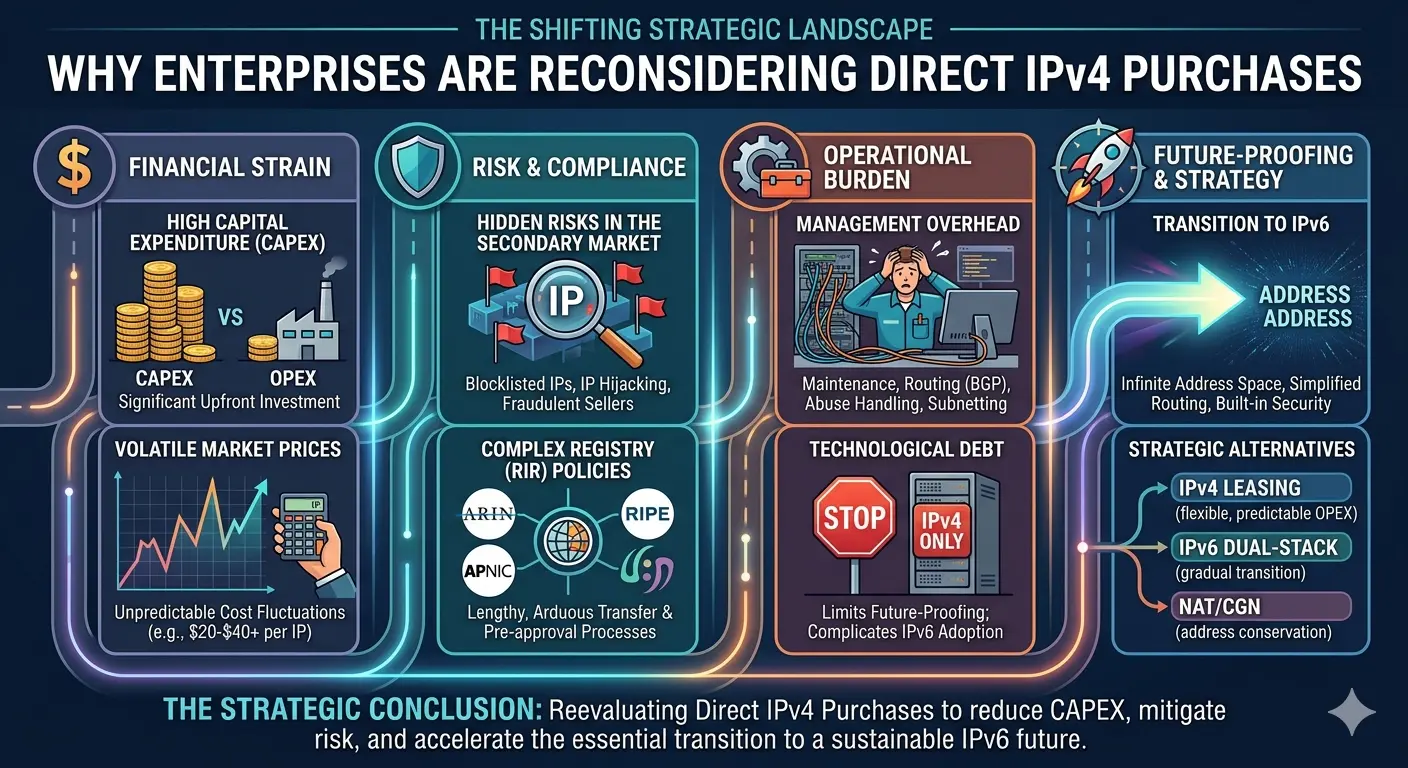
For years, buying IPv4 addresses appeared to offer enterprises the clearest form of long-term control.
Acquire a block, register it to the organization, route it through the corporate network, and retain it for as long as the infrastructure requires it.
That model can still make sense.
Organizations with stable long-term requirements, sufficient capital and the ability to manage registry and routing responsibilities may reasonably choose to purchase IPv4 resources.
But enterprises are increasingly looking beyond the simple question:
Should we own the IPv4 addresses?
A more useful question is:
What structure gives us the continuity, control and risk allocation our network actually requires?
That distinction matters because purchasing IPv4 addresses does not remove every dependency surrounding the resource.
An organization that directly holds IPv4 can still depend on:
- Regional Internet Registry processes;
- registry records;
- corporate documentation;
- routing configuration;
- RPKI;
- IRR;
- upstream providers;
- reverse DNS;
- reputation management; and
- internal operational continuity.
Direct ownership may change who carries those responsibilities, but it does not make them disappear.
For modern enterprises, IPv4 strategy is therefore becoming less about choosing between “ownership” and “non-ownership” and more about deciding how commercial rights, registry relationships and operational continuity should be structured.
Direct IPv4 Purchases: Quick Answer
Buying IPv4 addresses can provide long-term control and may suit organizations with stable, predictable requirements.
However, a direct purchase also means the organization generally takes on more responsibility for:
- registry relationships;
- transfer compliance;
- resource records;
- RPKI;
- IRR;
- reverse DNS;
- routing transitions;
- reputation; and
- long-term administration.
Direct holding therefore does not automatically eliminate registry-layer or operational risk.
For some organizations, leasing or a first-party continuity model may offer a better fit because the registry-facing relationship can remain upstream while the customer focuses on operational use.
The right model depends on:
continuity requirements + duration of use + capital strategy + registry exposure + operational control
There is no universal answer that buying or leasing is always better.
Why Enterprises Buy IPv4 Addresses
Direct IPv4 acquisition remains attractive for several legitimate reasons.
Long-Term Control
An organization with stable IPv4 requirements may prefer to acquire address space rather than depend on a recurring commercial agreement.
Predictable Capacity
Ownership can help an enterprise secure a known quantity of IPv4 resources for long-term infrastructure planning.
Strategic Asset Value
IPv4 has measurable commercial value because globally routable address space remains scarce.
An acquired portfolio may therefore represent both operational capacity and an economically valuable resource.
Reduced Provider Dependency
Direct acquisition can reduce dependence on a specific leasing provider for continued commercial access to the resource.
Portfolio Flexibility
Subject to applicable registry policy, contract terms and operational requirements, a holder may later decide to:
- continue using the space;
- transfer some resources;
- sell surplus blocks;
- restructure the portfolio; or
- potentially lease eligible capacity.
These are meaningful advantages.
The issue is not that direct IPv4 acquisition is inherently inefficient.
The issue is that ownership alone does not guarantee continuity.
Why Direct IPv4 Ownership Does Not Remove Registry-Layer Risk
An enterprise can purchase IPv4 resources and become the recognized registrant under the applicable registry framework.
But the resource continues to exist within several interconnected systems.
Commercial relationship
→ how the resource was acquired and what contractual rights exist
Registry state
→ which organization is recognized in the relevant RIR system
Routing authorization
→ which networks and ASNs are authorized or expected to originate the prefix
Operational use
→ which production systems actually depend on the addresses
Direct purchase can give the enterprise more direct control over some of these layers.
It does not merge them into one.
For example:
- A registry record does not itself announce a BGP route.
- A valid BGP announcement does not automatically establish every registry or contractual right.
- A ROA can authorize an ASN but does not determine the complete commercial relationship around the resource.
The practical status of IPv4 therefore depends on these layers remaining sufficiently aligned.
The Registry Relationship Moves to the Enterprise
When an organization directly acquires IPv4 and becomes the relevant registrant, the registry relationship generally moves closer to the operating entity.
That can provide direct administrative control.
It can also mean the organization assumes responsibility for maintaining that relationship.
Depending on the RIR and resource status, responsibilities may include:
- maintaining accurate organization records;
- meeting applicable contractual requirements;
- processing transfers correctly;
- maintaining contacts;
- managing RPKI;
- handling reverse DNS;
- responding to registry requests; and
- keeping corporate documentation aligned with registry information.
This is not inherently negative.
Registries perform necessary coordination functions.
Direct holding transfers registry-layer responsibility to the holder; it does not eliminate the registry layer.
For a deeper discussion of this issue, see Heng Lu's analysis of registry-layer structural risk.
Buying IPv4 Is Not the Same as Buying Independence From the System
An enterprise may own equipment outright.
If a router or server is purchased, the company can often physically control that asset without relying on a global registry to continue recognizing it.
IPv4 is different.
Globally routable Internet number resources require continued coordination.
The enterprise may control the commercial rights associated with the resource, but operational usefulness also depends on:
- accurate registration;
- routing acceptance;
- network configuration;
- security authorization; and
- global uniqueness.
This does not mean a registry controls the enterprise's network.
It means the IPv4 resource participates in a coordination system that remains relevant after the purchase.
That is why a direct IPv4 acquisition should be evaluated as both:
an asset transaction
and
a long-term infrastructure responsibility
Capital Commitment Is Another Reason Enterprises Reconsider Buying
The economics of buying and leasing IPv4 are structurally different.
A direct purchase generally requires significant upfront capital.
The total commitment depends on:
- CIDR size;
- market price;
- RIR;
- block reputation;
- transaction structure; and
- prevailing supply and demand.
For organizations requiring large quantities of IPv4, the capital commitment can be substantial.
That does not automatically make purchasing unattractive.
A company expecting to use the addresses for many years may conclude that acquisition provides appropriate long-term economics.
But where future requirements are uncertain, committing capital to permanent address ownership can reduce flexibility.
Questions enterprises should ask include:
- How long will we need this address space?
- Is our IPv4 requirement likely to grow or decline?
- Are workloads geographically stable?
- Could infrastructure providers change?
- What is the expected cost of capital?
- Will the addresses remain operationally useful to us in five or ten years?
- Do we need ownership, or primarily continuity of use?
For current market context, see LARUS's Global IPv4 Pricing & Market Statistics.
Leasing Can Reduce Upfront Capital Requirements
IPv4 leasing provides a different commercial structure.
Instead of purchasing the full economic interest in the resource upfront, the customer pays for continued use under a contractual arrangement.
This can reduce initial capital requirements and may allow capacity to scale more closely with operational needs.
However, leasing should not automatically be described as simply turning a capital asset into an operating expense.
Accounting treatment can depend on:
- contract terms;
- duration;
- applicable accounting standards; and
- the organization's own financial treatment.
The strategic advantage is better described as commercial flexibility.
For some enterprises, that flexibility is more valuable than permanent ownership.
For others, buying may still be preferable.
IPv4 Leasing Is Not Automatically Safer Either
It is equally important not to replace one oversimplification with another.
If direct ownership does not eliminate risk, leasing does not eliminate it either.
A conventional leasing arrangement can introduce its own dependencies.
For example:
- Who is the underlying resource holder?
- Who maintains the registry relationship?
- Who controls RPKI?
- Who manages IRR changes?
- What happens if the lease provider loses access to the addresses?
- Can the provider replace or reclaim the prefix?
- What happens at renewal?
- Who is responsible for abuse handling?
- What happens if the customer becomes operationally dependent on the same addresses?
These questions are particularly important for enterprises that use public IPv4 addresses as part of long-lived infrastructure.
The key issue is therefore not ownership versus leasing, but: where does the risk sit, and who is accountable when something changes?
The Risk of Multiple Intermediary Layers
Some IPv4 arrangements involve multiple commercial parties between the underlying resource holder and the end user.
Intermediation is not inherently problematic.
Brokers, marketplaces and service providers can perform useful roles in discovery, transaction execution and administration.
But additional layers can introduce additional dependencies when responsibilities are unclear.
A customer should understand:
- Who is the registered resource holder?
- Who is the contractual counterparty?
- Who can make registry changes?
- Who controls RPKI?
- Who supports routing changes?
- Who handles renewal?
- Who is accountable if the underlying resource becomes unavailable?
The more parties involved, the more important it becomes to define those responsibilities explicitly.
Rather than assuming that every intermediary creates risk, enterprises should evaluate whether each intermediary adds useful capability or simply adds another dependency.
Why First-Party IPv4 Matters
A first-party model changes the structure.
Instead of relying on a chain of unrelated counterparties, the IPv4 provider has a direct relationship with the underlying resources used to deliver the service.
For the customer, this can simplify accountability.
The objective is not to centralize:
- Internet governance;
- BGP routing;
- registry authority; or
- control of the customer's network.
The objective is to make responsibility for the commercial and registry-facing relationship clearer.
In a first-party continuity model:
Customer
→ focuses on operational use and network requirements
Provider
→ carries the upstream registry-facing relationship associated with the supplied resources
This can reduce the number of organizational boundaries the customer needs to manage.
It also provides a clearer answer to a crucial question:
Who is responsible for preserving my access to usable IPv4 capacity?
The Difference Between Leasing IPv4 and Leasing Continuity
Not every IPv4 lease offers the same operational outcome.
A conventional lease may provide:
temporary access to an address block
A continuity-oriented service is designed around a different objective:
preserving stable network identity and usable IPv4 capacity through changes in infrastructure or provider relationships
This distinction becomes important when IPv4 addresses are embedded in:
- firewall rules;
- allowlists;
- banking systems;
- third-party integrations;
- APIs;
- customer configuration;
- DNS;
- security policies;
- compliance documentation; and
- reputation databases.
Once this happens, renumbering may no longer be a minor technical task.
It can become a business-continuity event.
For organizations where long-term address stability matters, see LARUS IPv4 Leasing Continuity Assurance.
IPv4 Is Increasingly an Operational Infrastructure Layer
For many organizations, IPv4 should not be viewed only as a balance-sheet asset.
It is also part of the operational identity of the network.
A public IPv4 address may become embedded across many external systems that the enterprise does not directly control.
Changing it can require coordination with:
- customers;
- banks;
- SaaS providers;
- security vendors;
- partners;
- cloud providers;
- payment processors; and
- other third parties.
That means the strategic value of IPv4 can extend beyond the purchase price.
The enterprise may care more about:
continuity of the same usable network identity
than about formal ownership alone.
This does not make ownership unimportant.
It means ownership is only one component of infrastructure strategy.
Where IPv4 has become a long-term network identity, continuity should also avoid unnecessary provider lock-in. Customers should understand whether their operational identity can remain stable if infrastructure or service relationships change.
Direct Ownership vs Leasing vs First-Party Continuity
| Consideration | Direct Purchase | Conventional Leasing | First-Party Continuity Model |
|---|---|---|---|
| Upfront capital | Higher | Lower | Lower |
| Long-term ownership/control | Strong | Limited by contract | Service-based |
| Registry-facing responsibility | Primarily customer | Depends on provider structure | Primarily upstream provider |
| Capacity flexibility | Lower after purchase | Generally higher | Generally higher |
| Provider dependency | Lower commercially | Higher | Provider relationship remains important |
| Renumbering exposure | Depends on network changes | Can be significant at lease end | Designed to reduce continuity disruption |
| Administrative responsibility | Higher | Shared / provider dependent | More upstream responsibility |
| Best fit | Stable long-term demand | Flexible capacity needs | Stable operational identity and continuity |
This table is not a universal recommendation.
Different enterprises can reasonably reach different conclusions.
When Does Buying IPv4 Still Make Sense?
Direct acquisition can remain the appropriate strategy when an organization:
- expects stable long-term IPv4 requirements;
- has available capital;
- wants direct registry relationships;
- has internal expertise for RIR administration;
- can manage BGP, RPKI and IRR;
- values permanent control more than flexibility; and
- accepts the operational responsibilities associated with direct holding.
Buying should not be dismissed simply because leasing alternatives exist.
The important point is to purchase with a realistic understanding of the continuing dependencies.
For organizations considering acquisition, see Acquiring IPv4 Addresses.
When Can Leasing Make More Sense?
Leasing may be attractive when an organization:
- needs IPv4 quickly;
- wants to reduce upfront capital requirements;
- expects requirements to change;
- wants easier scaling;
- does not want to acquire a large permanent portfolio;
- prefers the provider to manage more registry-facing responsibilities; or
- requires capacity for a defined operational period.
For a complete overview, see IP Leasing: How IPv4 Leasing Works.
When Does Continuity Become More Important Than Ownership?
This is the question enterprises often underestimate.
Imagine an organization owns its IPv4 block.
The address is used across:
- 500 customer allowlists;
- financial APIs;
- enterprise VPN configurations;
- security systems;
- partners;
- cloud deployments; and
- external compliance records.
Formally owning the resource may be valuable.
But the business requirement is actually:
Do not force us to change this network identity unexpectedly.
In that situation, continuity becomes a primary design requirement.
The same principle applies to leased space.
If the enterprise becomes deeply dependent on a leased address range, the service architecture needs to address what happens during:
- renewal;
- provider change;
- network migration;
- infrastructure migration; and
- registry-layer disruption.
The strongest IPv4 strategy therefore evaluates not just who holds the resource, but how continuity is preserved.
A More Resilient Enterprise IPv4 Strategy
Instead of relying on one assumption—such as “ownership is safest” or “leasing is always more efficient”—enterprises can use three principles.
1. Continuity Over Assumptions of Ownership
Understand what actually keeps the network reachable.
That includes:
- registry state;
- routing;
- RPKI;
- IRR;
- upstream connectivity;
- DNS;
- reputation; and
- operational dependencies.
Ownership matters, but it should not substitute for continuity planning.
2. Make Risk Allocation Explicit
Identify who carries responsibility for:
- registry relationships;
- renewals;
- routing support;
- RPKI;
- IRR;
- reverse DNS;
- abuse;
- transfers; and
- continuity.
A structure is easier to manage when each responsibility has a clearly accountable party.
3. Use Flexibility Where It Creates Real Value
Some networks benefit from permanent acquisition.
Others benefit from leasing.
Others may require hybrid arrangements.
The correct strategy should be based on:
network requirements + duration + capital + risk + continuity
rather than an ideological preference for either ownership or leasing.
Registry Coordination and Operational Reality Are Different Layers
This distinction is particularly important in IPv4 infrastructure.
A registry performs necessary coordination functions.
Those functions support:
- uniqueness;
- registration;
- transfer records;
- RPKI;
- reverse DNS; and
- related services.
But the registry does not operate every network using those resources.
A registry record describes an important coordination state. It is not identical to a BGP route, a customer contract, an operational dependency, or the complete commercial reality of the resource.
Likewise, a running BGP route does not by itself establish every registry or contractual right.
A resilient IPv4 strategy recognizes these different layers and keeps them aligned without treating any one layer as the entire system.
Where registry-layer functions become critical dependencies, continuity is stronger when those functions are transparent, auditable and not dependent on a single institutional failure point.
Frequently Asked Questions
Is buying IPv4 safer than leasing IPv4?
Not automatically. Buying may provide greater long-term commercial control, but it also places registry, administrative and operational responsibilities directly on the holder. Leasing creates different dependencies. The safer model depends on the specific structure and continuity requirements.
Does owning IPv4 eliminate registry risk?
No. Direct holders still interact with registry systems and may depend on registration accuracy, contractual processes, RPKI, reverse DNS and other registry-supported functions.
Why would an enterprise lease instead of buy IPv4?
Leasing can reduce upfront capital requirements, provide capacity flexibility and shift some administrative responsibilities upstream. It may be appropriate where long-term ownership is not essential.
Is IPv4 leasing always better than buying?
No. Organizations with stable long-term demand and the capability to manage their own resources may reasonably prefer direct acquisition.
What is a first-party IPv4 model?
A first-party model means the service provider has a direct relationship with the IPv4 resources used to serve the customer rather than relying entirely on a chain of unrelated intermediaries.
Does a first-party provider control Internet governance or routing?
No. The objective is not to centralize Internet governance or customer routing. A first-party model can instead make responsibility for the commercial and registry-facing relationship clearer while the customer remains responsible for its own operational network where applicable.
Are IPv4 brokers risky?
Not inherently. Brokers can provide useful transaction services. Risk can increase when multiple intermediary layers make it unclear who controls registry relationships, routing support, renewal or continuity.
What is the main risk of direct IPv4 ownership?
There is no single risk. Direct holders need to manage commercial, registry and operational responsibilities themselves. Ownership does not automatically guarantee routing or continuity.
Can a leased IPv4 address become part of a company's network identity?
Yes. When an address becomes embedded in customer allowlists, APIs, security policies, banking systems and other external dependencies, changing it can become operationally difficult.
How should an enterprise choose between buying and leasing IPv4?
Evaluate expected duration, capital requirements, registry responsibility, internal expertise, routing needs, continuity requirements and the cost of future renumbering.
Conclusion
Enterprises are not reconsidering direct IPv4 purchases because ownership has stopped being valuable.
IPv4 ownership can still provide:
- long-term control;
- strategic capacity;
- asset value; and
- reduced dependence on a leasing contract.
What has changed is the recognition that ownership alone does not solve every infrastructure problem.
A directly held IPv4 block still exists within:
commercial relationships + registry systems + routing authorization + operational networks
For some organizations, assuming responsibility for all of those layers is the right decision.
For others, leasing or a first-party continuity model can create better alignment between capital, operational needs and registry-facing responsibilities.
The strategic question is therefore no longer simply:
Should we buy IPv4 or lease it?
A better question is:
Which structure gives our network the clearest responsibility, appropriate control and strongest continuity for the way we actually use IPv4?
That is the foundation of a more resilient enterprise IPv4 strategy.
For organizations evaluating long-term IPv4 capacity, explore LARUS IPv4 Leasing Continuity Assurance.
For businesses comparing commercial models, read IP Leasing: How IPv4 Leasing Works, Models, Costs & Benefits.
Keep your network moving
Turn the next answer into your next network move.
Build with Unlimited IPv4 and explore LARUS Continuity for the network your customers depend on.