
Technical guide
Understanding IP Address Blocks: IPv4, IPv6, and Network Structure
An IP address block is the operating unit behind a scalable network. Learn how CIDR, IPv4 and IPv6 sizing turn address space into customer capacity, clean routing and room to grow.
Explore IPv4 Continuity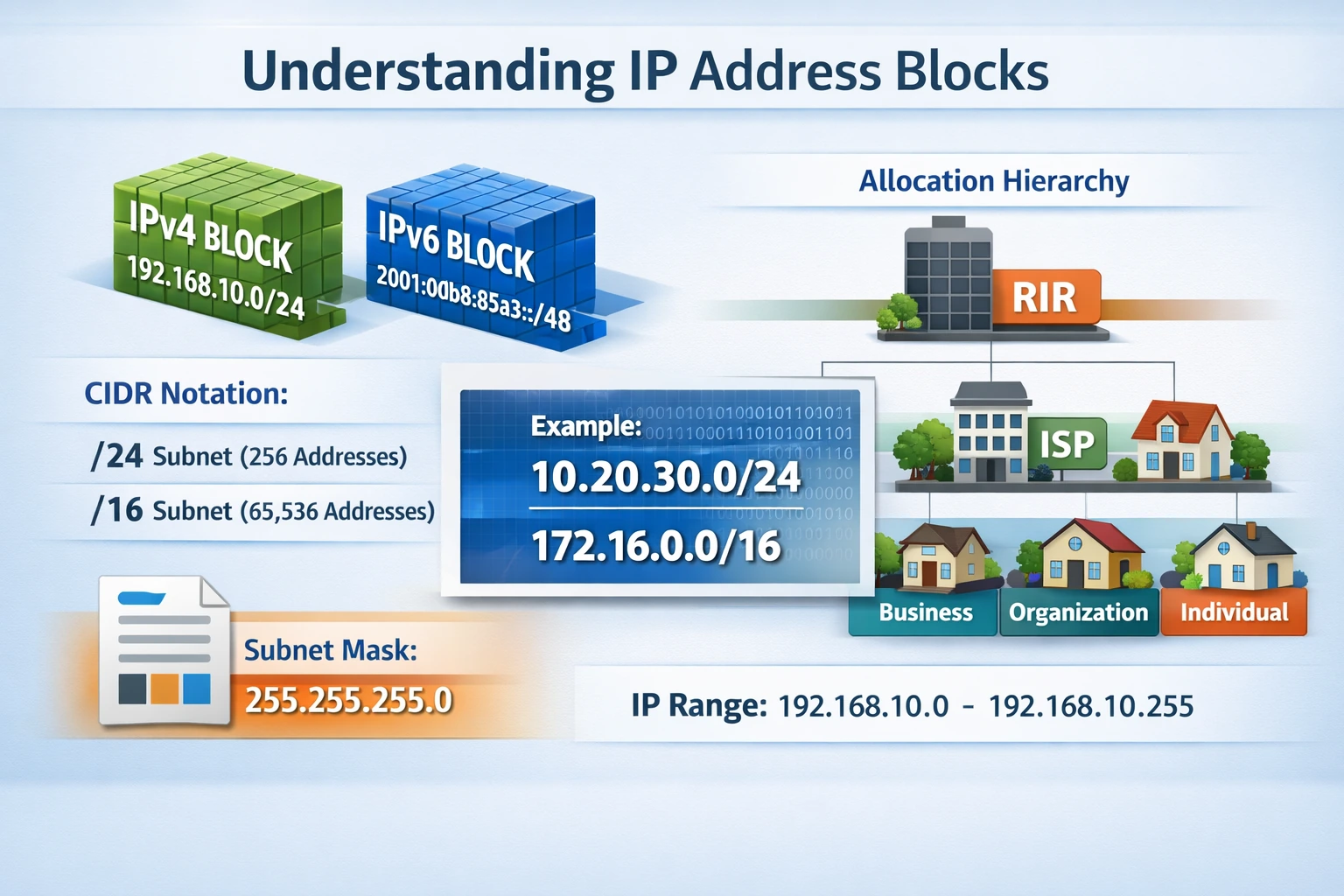
When you run an ISP, hosting platform, cloud environment or data centre, you do not plan one address at a time. You plan blocks: clean ranges that can be routed, assigned to customers, segmented across locations and expanded as demand arrives.
What is an IP address block?
An IP address block is a continuous range that shares a network prefix. It is written in CIDR notation, such as 192.168.1.0/24 for IPv4 or 2001:db8::/32 for IPv6. The prefix length describes how much of the address identifies the network; the remaining bits identify space inside that block.
A shorter prefix usually represents a larger block. A longer prefix is smaller and more specific. This simple notation lets engineers design subnets, announce routes and match capacity to a real customer or service plan.
Why blocks matter to operators
- Capacity: group addresses around customer tiers, services or locations instead of maintaining a fragile list of individual addresses.
- Routing: keep announcements understandable and make it easier to aggregate related networks.
- Growth: reserve a clear path from the next deployment to the next region without redesigning the whole plan.
- Continuity: keep public services, allowlists and integrations aligned with an address identity that can stay in service.
That is the difference between having addresses and having an address plan that helps the business move.
IPv4 and IPv6: plan for the customers you serve
IPv4 uses 32-bit addresses and dotted-decimal notation; IPv6 uses 128-bit addresses and hexadecimal notation. A larger address space does not automatically connect IPv6-only services to IPv4-only customers. When you run both protocols, plan routing, firewalls and monitoring for both. See how IPv4 and IPv6 fit into your infrastructure.
How CIDR notation works
CIDR means Classless Inter-Domain Routing. In 10.0.0.0/16, the /16 means that the first 16 bits identify the network and the remaining 16 bits provide space inside it. The same logic works across IPv4 and IPv6; only the total address length changes.
CIDR replaced the old assumption that every network must be a fixed Class A, B or C shape. It gives operators the precision to choose the block they actually need and the flexibility to aggregate routes when the topology grows.
For the calculation behind each prefix and route aggregation, see Classless Inter-Domain Routing explained.
Common IPv4 and IPv6 sizes
| CIDR | Total addresses | Planning use |
|---|---|---|
/24 | 256 IPv4 addresses | Small routed unit, customer segment or deployment |
/23 | 512 IPv4 addresses | Two /24 units with more room for assignments |
/22 | 1,024 IPv4 addresses | Growing service or multi-segment environment |
/20 | 4,096 IPv4 addresses | Regional, hosting or cloud capacity |
/16 | 65,536 IPv4 addresses | Large-scale network planning |
Public capacity and private ranges
A /24 contains 256 total IPv4 addresses; the number assignable to hosts depends on the subnet design. Private ranges 10.0.0.0/8, 172.16.0.0/12 and 192.168.0.0/16 serve internal networks and are not routed on the public Internet. Match the public capacity you need to current IPv4 pricing, with a clear plan for customer growth.
Common IPv6 block sizes
IPv6 has 128 bits, so a prefix of length p contains 2128 − p addresses. Plan around sites and /64 subnets, rather than treating every address as a separate customer. A /56 gives a customer 256 /64 networks; a /48 gives 65,536. The allocation should leave room for the customer’s network to develop.
| CIDR | Total IPv6 addresses | Number of /64 subnets | Planning use |
|---|---|---|---|
/64 | 264 | 1 | One LAN or service subnet |
/56 | 272 | 256 | Customer site with room for 256 subnets |
/48 | 280 | 65,536 | Organization or campus with multiple networks |
/32 | 296 | 4,294,967,296 | Provider allocation with room for many customer sites |
Give every site room to grow
Use a hierarchy of regions, sites and subnets so your team can allocate consistently and summarize routes. Read the IPv6 introduction and IPv6 deployment guide alongside your existing IPv4 plan. Compare customer reach and engineering effort as well as address counts: Heng Lu’s Note on IPv6 and scarcity explains why operating costs and network effects belong in that decision.
The right size depends on your routing model, customer demand and growth plan. A larger block is useful only when the network can route and operate it cleanly; the goal is practical capacity, not a bigger number on paper.
Who coordinates address blocks?
IANA coordinates global address pools; Regional Internet Registries maintain regional allocation and registration, and operators organize customer assignments. Accurate records and routing make those numbers useful to your business. The RIR overview explains these roles; IP address space explains the underlying resource.
Operate a block in the real world
An address block becomes valuable when it works across the systems around it: BGP policy, reverse DNS, security rules, customer provisioning, monitoring, abuse handling and support. Before you commit to a design, map the block to the services it must carry and the locations that must reach it.
For more context on the address itself, read What is an Internet Address?.
For a cloud deployment, reserve non-overlapping ranges for your VPCs, customer networks and security zones. Divide a larger block into subnets, record assignments and keep route aggregation consistent with the topology. This makes the next customer or location easier to bring online.
Different address plans create different business opportunities: unused capacity can become cash through selling IPv4 to LARUS; local infrastructure can support customers through the delivery partner programme. For the capacity your own network needs, the next step is Continuity.
Quick answers for your address plan
Why do /24 and /64 matter?
An IPv4 /24 contains 256 addresses and is a familiar routed or commercial unit. An IPv6 /64 is a common LAN subnet size. A larger site allocation such as /56 or /48 gives you multiple /64 networks, so departments and services can grow independently.
Choose capacity that keeps moving
LARUS gives network operators a direct path to Unlimited IPv4 and IPv4 Continuity, so capacity can follow customer demand without forcing every growth decision into a renumbering project. Explore LARUS Continuity for the next block your network needs.
Technical references
Keep your network moving
Turn the next answer into your next network move.
Build with Unlimited IPv4 and explore LARUS Continuity for the network your customers depend on.