
Technical guide
Pros and Cons of Short-Term IPv4 Rental for Business Projects
Explore the pros and cons of short-term IPv4 rental for business projects, including cost, flexibility, IP reputation, routing, renewal risks, and key checks before renting.
Explore IPv4 Continuity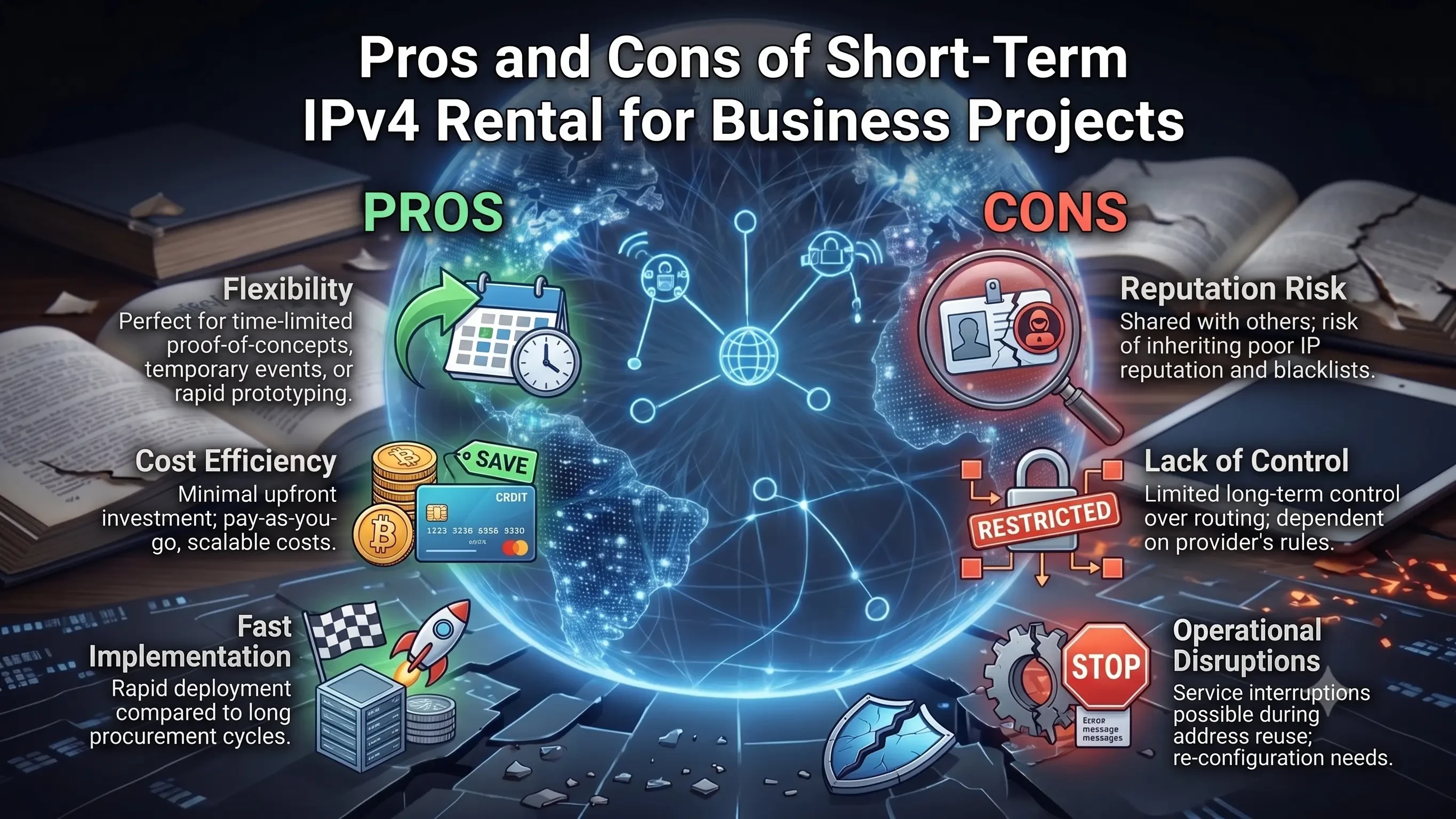

IPv4 addresses remain essential for many online services, even as IPv6 adoption continues to grow. For businesses that need extra IP capacity but do not want to make a long-term purchase, short-term IPv4 rental can be a practical solution.
Short-term IPv4 rental gives companies access to IPv4 resources for temporary or flexible needs, such as cloud migration, hosting expansion, network testing, seasonal traffic, VPN infrastructure, data center deployment, or project-based scaling. Instead of buying address space outright, businesses can rent IPv4 addresses for the period they need and adjust capacity as demand changes.
However, renting IPv4 addresses also comes with operational considerations. IP reputation, routing authorization, renewal terms, geolocation accuracy, abuse handling, and provider reliability can all affect whether the rented IP space is suitable for production use.
In this article, we look at the pros and cons of short-term IPv4 rental and when it makes sense for business projects.
What Is Short-Term IPv4 Rental?
Short-term IPv4 rental is the temporary use of IPv4 address space under a leasing arrangement. The business gets access to IP addresses for a defined period, while the address holder or provider retains ownership of the IP resources.
This model is different from buying IPv4 addresses, where the buyer takes on a permanent asset and handles more of the ownership, registry, and long-term management responsibilities. For a general overview of how IPv4 rental works, you can read LARUS’ guide on IPv4 address rental.
Short-term rental is often used when a company needs IPv4 addresses quickly, but does not want to commit capital to a long-term purchase.
Common Business Uses for Short-Term IPv4 Rental
Businesses may consider short-term IPv4 rental for several reasons, including:
-
Temporary infrastructure expansion
-
Cloud migration or hybrid cloud deployment
-
Hosting and data center projects
-
Network testing and proof-of-concept environments
-
Seasonal traffic demand
-
VPN, proxy, or privacy-related services
-
ISP or telecom capacity planning
-
New market testing
-
Emergency capacity replacement
For these use cases, flexibility is often more important than long-term ownership. The business needs working IPv4 resources, but only for a specific period or project.
Pros of Short-Term IPv4 Rental
1. Lower Upfront Cost
One of the biggest advantages of renting IPv4 addresses is that it reduces upfront capital spending. Buying IPv4 address blocks can require a significant investment, especially for larger allocations. Short-term rental allows businesses to access IPv4 resources without committing to a permanent purchase.
This is useful for companies that need IP space for a temporary project, early-stage deployment, or uncertain demand forecast. Instead of buying more addresses than needed, they can rent capacity based on current requirements.
2. Faster Access to IPv4 Resources
Short-term IPv4 rental can be faster than purchasing address space. Buying IPv4 addresses may involve negotiations, transfer procedures, registry requirements, and longer approval timelines.
For businesses with urgent deployment needs, rental can provide a quicker path to usable address space. This is especially valuable for hosting providers, network operators, SaaS platforms, and infrastructure teams that need to scale services quickly.
Managed leasing platforms such as i.lease managed IPv4 leasing can also support operational readiness through clean IPv4 inventory, LOA generation, routing support, RPKI, rDNS, geolocation, and abuse management.
3. Flexibility for Temporary Projects
Not every IPv4 requirement is permanent. Some businesses need additional IP addresses for a few months, a seasonal campaign, a migration period, or a temporary network buildout.
Short-term IPv4 rental gives companies the flexibility to increase or reduce capacity as the project changes. This can be more efficient than buying IPv4 addresses for a temporary requirement and later holding unused resources.
4. Useful for Testing and Proof of Concept
IPv4 rental is also useful for testing new services. A business may want to test a new region, product, application, or network setup before making a long-term investment.
Renting IP addresses allows teams to validate technical requirements, customer demand, routing performance, geolocation behavior, and operational workflows before committing to permanent infrastructure.
5. Easier Budget Planning for Project-Based Work
For project-based teams, rental costs can be easier to assign to a specific campaign, deployment, or business unit. Instead of treating IPv4 as a capital asset, the company can manage it as an operating expense for the duration of the project.
This can make budgeting simpler, especially when the business does not know whether the IP requirement will continue after the project ends.
6. Less Long-Term Ownership Responsibility
Buying IPv4 addresses can bring additional responsibilities, including registry coordination, compliance, asset management, routing security, abuse management, and long-term reputation monitoring.
With rental, the provider may handle part of the operational burden, depending on the service model. For businesses that want capacity without managing every ownership detail, a managed or first-party leasing structure can be attractive.
LARUS offers IPv4 leasing , which focuses on keeping leased IPv4 resources usable through controls such as routing validity, renewal, rDNS, reputation, abuse workflow, geolocation, and support response.
Cons of Short-Term IPv4 Rental
1. Renewal Uncertainty
The biggest disadvantage of short-term IPv4 rental is renewal uncertainty. If the rented block is needed longer than expected, the business must confirm whether the provider can extend the lease.
If renewal is not available, the company may need to renumber services, update routing, change DNS records, modify firewall rules, notify customers, or migrate workloads to another block. For non-critical projects, this may be manageable. For production environments, renewal risk can become a serious operational issue.
This is why businesses should understand renewal terms before renting IPv4 addresses, especially if the addresses will support customer-facing services.
2. IP Reputation Risk
Not all IPv4 addresses have the same reputation. Some IP blocks may have a history of spam, abuse, blocklisting, proxy activity, malware, or poor sender reputation.
Using IP addresses with a bad history can affect email delivery, platform access, fraud checks, user trust, and service reliability. Before renting IPv4 addresses, businesses should check whether the provider screens IP reputation and offers support if reputation issues appear.
Clean, pre-vetted IPv4 resources are especially important for hosting, SaaS, VPN, email, e-commerce, and customer-facing platforms.
3. Geolocation Issues
IP geolocation can affect user experience, compliance workflows, content delivery, advertising, analytics, payment checks, and access controls. If rented IPv4 addresses are incorrectly mapped to the wrong country or region, users may see wrong content, blocked services, or inaccurate location-based behavior.
Businesses should ask whether the provider supports geolocation correction and whether the IP blocks are suitable for the target market.
4. Routing and Authorization Requirements
Renting IPv4 addresses is not only a commercial arrangement. The IP space must also be technically usable. Businesses may need a Letter of Authorization, routing object, ROA/RPKI setup, rDNS delegation, and coordination with their upstream provider or data center.
If these steps are delayed or incomplete, the IP addresses may not be ready for production use. Before signing a rental agreement, businesses should confirm what routing support is included and how quickly the provider can prepare the block.
5. Abuse Handling Responsibilities
Abuse reports can affect the usability of rented IP addresses. If complaints are not handled properly, the block may face reputation damage, filtering, blacklisting, or service interruptions.
Businesses should understand who is responsible for abuse handling, how reports are processed, what fees may apply, and what happens if repeated abuse complaints occur. This is especially important for providers operating hosting, VPN, proxy, cloud, or high-volume user platforms.
6. Not Always Suitable for Permanent Infrastructure
Short-term IPv4 rental is not always the best option for long-term, mission-critical infrastructure. If a business knows it will need the same IP resources for many years, buying IPv4 addresses or choosing a longer-term continuity-focused lease may be more suitable.
Short-term rental works best when the business values flexibility. For permanent infrastructure, the company should compare cost, renewal terms, control, risk tolerance, and operational requirements.
7. Provider Dependency
When a business rents IPv4 addresses, it depends on the provider for continuity, documentation, support, renewal, and operational response. If the provider is slow, unclear, or dependent on multiple intermediaries, the business may face delays when something goes wrong.
This is why provider selection is important. Businesses should look for transparency, clear support processes, routing readiness, reputation management, and continuity planning.
When Short-Term IPv4 Rental Makes Sense
Short-term IPv4 rental may be a good option when:
-
The project has a limited timeline
-
The company needs IPv4 capacity quickly
-
Demand is uncertain
-
The business wants to avoid large upfront spending
-
The IP requirement is tied to testing, migration, or temporary growth
-
The company wants managed operational support
-
The workload can tolerate some lease-term flexibility
For example, a hosting provider launching a temporary customer environment may prefer rental because the need may not continue after the contract period. A cloud migration team may also rent IPv4 addresses during the transition period before retiring legacy infrastructure.
When Short-Term IPv4 Rental May Not Be Suitable
Short-term IPv4 rental may not be the best option when:
-
The IP addresses are required for long-term production
-
Renumbering would be expensive or disruptive
-
Customers depend on stable IP addresses
-
The business needs guaranteed renewal
-
The workload requires strict compliance or audit controls
-
The company wants full long-term control of the asset
In these cases, the business may need a stronger continuity structure, a longer lease term, or a purchase strategy.
Checklist Before Renting IPv4 Addresses Short Term
Before renting IPv4 addresses for a short-term project, businesses should ask:
-
What is the lease duration?
-
Can the lease be renewed?
-
Is renewal guaranteed or subject to availability?
-
Are the IP addresses clean and reputation-checked?
-
Are the blocks currently blacklisted?
-
Is LOA support included?
-
Is RPKI/ROA setup available?
-
Is rDNS delegation included?
-
Can geolocation issues be corrected?
-
How are abuse reports handled?
-
What happens if an IP block becomes unusable?
-
What support SLA is provided?
-
Are there setup fees, abuse fees, or early termination fees?
-
Can the provider support future scaling?
-
Is the provider the direct source or part of a reseller chain?
This checklist helps reduce the risk of renting IP addresses that are technically available but operationally unsuitable.
Final Thoughts
Short-term IPv4 rental can be a smart solution for businesses that need flexible IP capacity without buying address space outright. It offers lower upfront cost, faster access, project-based flexibility, and easier scaling for temporary infrastructure needs.
However, the advantages depend heavily on the quality of the provider and the operational controls behind the lease. IP reputation, routing validity, geolocation accuracy, abuse handling, renewal terms, and support response all matter.
For businesses that only need temporary IPv4 capacity, short-term rental can be efficient and cost-effective. For production environments where renumbering would be disruptive, companies should look beyond price and consider continuity, routing, reputation, and renewal protection.
To learn more about IPv4 rental fundamentals, read LARUS’ guide to IPv4 address rental. For operationally managed leasing, explore i.lease managed IPv4 leasing. If your business needs stronger continuity protection for leased IPv4 resources, visit LARUS IPv4 leasing.
Frequently Asked Questions About Short-Term IPv4 Rental
1. What is short-term IPv4 rental?
Short-term IPv4 rental is the temporary use of IPv4 address space for a defined period, usually for business projects that do not require permanent IP ownership. It is commonly used for cloud migration, hosting expansion, testing, seasonal traffic, or temporary network deployment.
2. Is short-term IPv4 rental better than buying IPv4 addresses?
Short-term IPv4 rental may be better when a business needs IP addresses quickly, has temporary demand, or wants to avoid a large upfront purchase. Buying IPv4 addresses may be more suitable for long-term infrastructure where the company needs permanent control and stable IP resources.
3. What should businesses check before renting IPv4 addresses?
Businesses should check IP reputation, blacklist history, geolocation accuracy, routing authorization, LOA availability, RPKI/ROA support, rDNS delegation, renewal terms, abuse handling, and provider support. These checks help ensure the rented IPv4 addresses are usable for production.
4. What are the main risks of renting IPv4 addresses short term?
The main risks include renewal uncertainty, poor IP reputation, incorrect geolocation, routing delays, abuse complaints, contract limitations, and provider dependency. These risks can affect service reliability if they are not reviewed before signing a rental agreement.
5. Who should consider short-term IPv4 rental?
Short-term IPv4 rental is suitable for businesses that need temporary or flexible IP capacity, such as hosting providers, cloud platforms, SaaS companies, ISPs, telecom operators, data centers, VPN providers, and businesses running migration or testing projects.
Keep your network moving
Turn the next answer into your next network move.
Build with Unlimited IPv4 and explore LARUS Continuity for the network your customers depend on.