
Technical guide
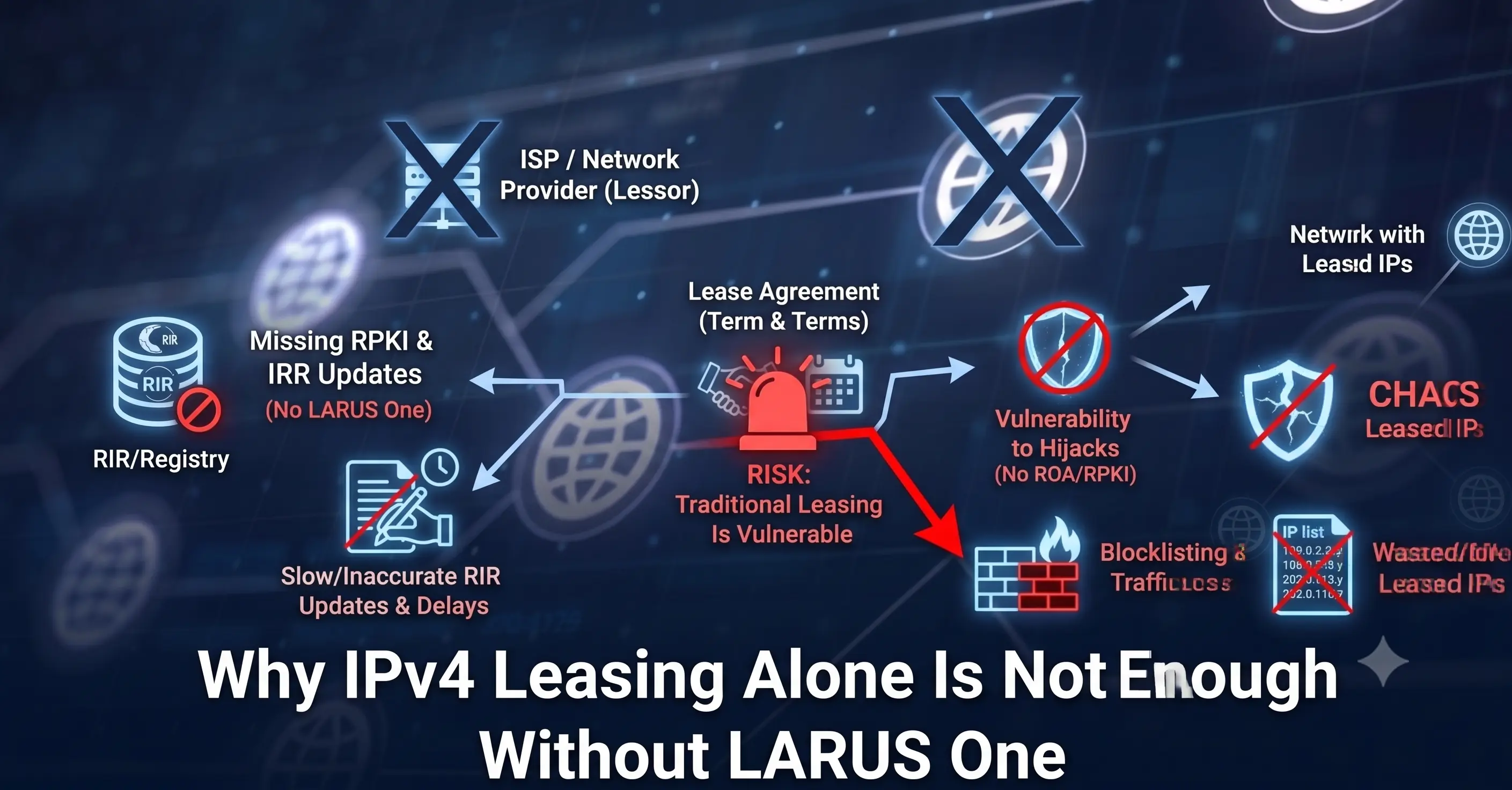
Why IPv4 Leasing Alone Is Not Enough Without LARUS One
IPv4 leasing alone isn’t enough—discover why businesses need a complete strategy like LARUS ONE for stable, scalable, and secure IP continuity.
Explore IPv4 Continuity
Quick Answer
Traditional IPv4 usage models often rely on fragmented third-party arrangements and indirect operational structures, which can introduce exposure to external policy changes, intermediary operational dependencies, and potential uncertainty in long-term network continuity.
LARUS One is designed as a first-party network identity layer for IPv4 resources, aiming to improve operational continuity, support vendor-agnostic cloud migration via BYOIP, and provide structured long-term renewal models while reducing the need for unnecessary network renumbering.
Supporting industry context can be found in LARUS launches LARUS One partnership framework.
According to Lu Heng’s analysis in The Economics of Network Identity, Customer Continuity, and Provider Revenue, this model is aligned with efforts to reduce the financial and operational risks associated with traditional IP leasing structures.
Introduction
For over a decade, enterprises scaling through the IPv4 shortage have typically relied on leasing models when direct allocation was not practical. This led to the emergence of brokers, marketplaces, and layered subleasing structures that enabled short-term access to IPv4 resources.
While effective for basic connectivity needs, modern enterprise environments have evolved significantly. Infrastructure today spans multi-cloud, hybrid environments, edge computing, and globally distributed APIs, where IP space is tightly coupled with application stability and security policy design.
In this context, a public IPv4 block is increasingly treated as part of an organization’s network identity layer—a stable reference point for systems, services, and integrations that depend on consistent addressing.
For additional background on how IPv4 leasing structures operate in practice, see: understanding what is involved in IPv4 Lease
What Is Network Identity in Modern Infrastructure?
Network Identity refers to the role IPv4 addresses play beyond simple connectivity. In modern architectures, public IPs are often embedded into:
- API exposure and service endpoints
- Firewall and security policies
- Multi-cloud and hybrid connectivity
- Enterprise integration dependencies
Because of this, changes in IP space may introduce downstream operational overhead. LARUS One focuses on helping enterprises maintain continuity of this identity layer across infrastructure changes.
For a broader industry perspective on why this is becoming a board-level infrastructure issue, you can refer to this analysis of network identity trends.
Key Considerations in Traditional IPv4 Leasing
Traditional leasing structures often involve multiple intermediaries between the enterprise and the underlying IP resource holder. This introduces several operational considerations:
-
Indirect ownership structures
IP resources may be accessed through brokers or multi-party agreements rather than direct control. -
Compliance dependency
Continuity can be influenced by upstream policy alignment with Regional Internet Registries (RIRs), such as RIPE, ARIN, or APNIC. -
Operational renewal uncertainty
Lease extensions and pricing conditions may vary depending on underlying ownership decisions.Lease extensions and pricing conditions may vary depending on underlying ownership decisions, market demand, and supply constraints.
For a detailed breakdown of current IPv4 lease pricing trends and what to expect in 2026,
see: Current IPv4 Lease Rates: What to Expect in 2026
-
Migration overhead
Changing IP space during infrastructure migration can require updates across routing, firewall rules, and external integrations.
System architecture choices often determine how resilient a network remains under change. In many cases, the stability of IP continuity depends on the specific provider structure and contract model in place.
Traditional IPv4 Leasing vs. LARUS One
| Capability & Feature | Traditional IPv4 Leasing | LARUS One Network Identity |
|---|---|---|
| Provider Model | Brokers & multi-party structures | Direct, first-party resource management |
| Regulatory Exposure | Depends on upstream ownership and RIR alignment | Structured compliance approach within managed framework |
| Infrastructure Portability | Often tied to specific environments or providers | Vendor-agnostic (supports BYOIP models) |
| Renewal Structure | Varies based on market and ownership conditions | Structured long-term renewal design (where applicable) |
How LARUS One Supports Network Continuity
1. Direct Resource Management
LARUS One operates with direct control over its IPv4 resource pool structure, reducing reliance on fragmented intermediary chains and improving visibility into resource governance.
2. BYOIP-Enabled Cloud Flexibility
Through Bring Your Own IP (BYOIP) integration, enterprises can maintain consistent public IP usage across different environments, including:
- Multi-cloud deployments
- Hybrid infrastructure
- Data center and edge architectures
This helps reduce the operational impact of infrastructure migration.
3. Structured Long-Term Continuity Model
LARUS One is designed around long-term usage structures that aim to reduce unnecessary renumbering events and support more stable planning for enterprise network architectures.
Conclusion
As enterprise infrastructure becomes more distributed and dynamic, IPv4 space is increasingly part of an organization’s operational architecture rather than a standalone utility.
LARUS One is designed to support this shift by providing a structured approach to IPv4 resource management that emphasizes:
- Continuity across infrastructure changes
- Cloud and vendor flexibility
- Reduced migration overhead
- Long-term network planning stability
Start your IPv4 leasing request today — and build on a network identity layer designed for the future.
Frequently Asked Questions (FAQ)
1: What differentiates LARUS One from traditional IPv4 brokers?
Traditional brokers typically operate as intermediaries between buyers and resource holders. LARUS One focuses on a first-party resource management model designed to improve visibility and reduce dependency on fragmented intermediary chains.
2: What does “Network Identity” mean?
It refers to the role of public IPv4 space as a stable reference layer in modern infrastructure, connecting APIs, cloud systems, and security policies across environments.
3: How does LARUS One support infrastructure continuity during change?
By focusing on structured IP management and BYOIP compatibility, LARUS One is designed to help maintain consistent addressing across infrastructure transitions where possible.
4: Does LARUS One support BYOIP?
Yes. LARUS One is designed to integrate with BYOIP-capable environments, enabling IP continuity across supported cloud and network providers.
5: Why can IPv4 changes be costly in cloud migration?
Because IPs are often embedded in firewall rules, allowlists, and service integrations, changes may require updates across multiple dependent systems. Maintaining consistent IP space can reduce this overhead.
Keep your network moving
Turn the next answer into your next network move.
Build with Unlimited IPv4 and explore LARUS Continuity for the network your customers depend on.