
Technical guide
What is IP Address WHOIS
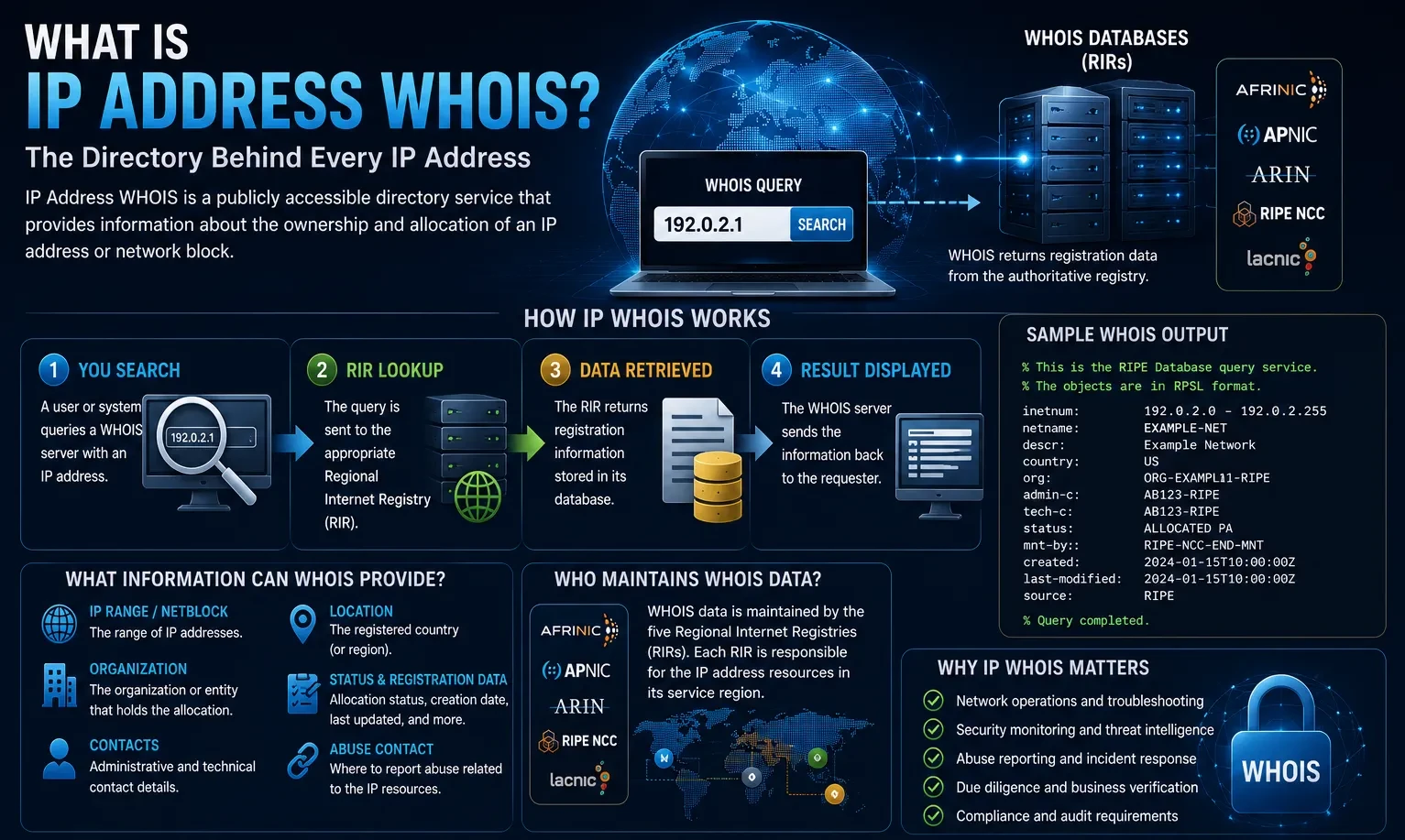
IP address WHOIS is a protocol and service that provides information about the ownership, registration, and location of an IP address. WHOIS databases are maintained by regional internet registries (RIRs) that collect and manage the data of individuals or organizations that have been assigned IP addresses. When someone queries an IP address using WHOIS, they receive detailed information about who owns the address block, how to contact them, and sometimes additional technical details. This tool is commonly used in network management, cybersecurity, and law enforcement to track down information about IP address origins and to understand more about potential internet threats or issues.
Table of Contents
Types of Information Available from an IP Address WHOIS Lookup
Applications of IP Address WHOIS
How IP Address WHOIS Works
WHOIS is both a database and a query protocol that is used to look up information about who owns domain names, IP addresses, and autonomous system numbers (ASNs). For IP addresses, the WHOIS service is primarily concerned with the allocation and assignment of IP ranges. The service works by querying a distributed set of databases maintained by the five major regional internet registries:
- ARIN (American Registry for Internet Numbers) – Manages IP address allocations for North America.
- RIPE NCC (Réseaux IP Européens Network Coordination Centre) – Covers Europe, the Middle East, and parts of Central Asia.
- APNIC (Asia-Pacific Network Information Centre) – Oversees IP address distribution in the Asia-Pacific region.
- LACNIC (Latin American and Caribbean Internet Addresses Registry) – Manages IP resources in Latin America and the Caribbean.
- AFRINIC (African Network Information Centre) – Focuses on Africa and the Indian Ocean region.
When an IP address is entered into a WHOIS search tool, the query is directed to the appropriate RIR based on the region associated with that IP address. The WHOIS server then returns data that typically includes information like the name of the organization that owns the address, the contact information, details about the registration, and sometimes technical details about the network.
Types of Information Available from an IP Address WHOIS Lookup
An IP address WHOIS lookup provides several key pieces of information that can be used to better understand the context and ownership of the IP address in question. Here are some common data points you might find:
- Registrant Information: This includes details about the organization or individual who registered the IP address, such as their name, company name, mailing address, and phone number.
- Administrative and Technical Contacts: Contact details of individuals or teams responsible for handling technical issues or administrative matters related to the IP address.
- IP Address Range: Information about the specific block of IP addresses assigned to the registrant, which helps identify whether it is a small range or a large network.
- Registration Date: The date on which the IP address was registered or last updated.
- NetName: A descriptive name assigned to the network, often indicating the organization or service it belongs to.
- Abuse Contact Information: Contact details for reporting misuse or abuse of the IP address, which is important for addressing issues like spam, hacking attempts, or DDoS attacks.
Applications of IP Address WHOIS
IP address WHOIS is a valuable tool in various fields, especially in network security, IT management, and legal enforcement. Here are some of its common applications:
- Cybersecurity and Incident Response: WHOIS lookups are often the first step in investigating suspicious activity on a network. If an organization detects malicious traffic, a WHOIS query can quickly reveal who owns the attacking IP address and provide contact information to report the incident or request assistance.
- Network Management: System administrators use IP WHOIS data to manage their own networks, track down configuration issues, and ensure that IP address allocations are correctly implemented. Knowing who controls a specific IP address can help prevent conflicts and improve network reliability.
- Spam and Abuse Control: Email service providers and network operators use WHOIS to trace back the source of spam emails or malicious traffic to their originating IP addresses. The abuse contact information found in the WHOIS record can be used to submit complaints or blocklist problematic IPs.
- Law Enforcement and Legal Investigations: Law enforcement agencies rely on WHOIS data to identify the owners of IP addresses involved in cybercrime activities, such as fraud, hacking, and illegal content distribution. This data provides a crucial starting point for tracking down offenders and securing the necessary information for legal action.
- Domain Ownership Verification: In some cases, businesses or individuals may need to verify the legitimacy of a website or an online service. By performing a WHOIS lookup on the IP address, they can validate whether the domain or server is owned by a reputable entity or if it might be linked to potential scams or threats.
Limitations and Privacy Concerns
While IP address WHOIS is a powerful tool, it has its limitations and potential privacy concerns. Many organizations use privacy protection services to hide their true contact information from WHOIS records, making it harder to identify the actual owners of the IP address. This practice is often employed to prevent spam and to protect against potential misuse of contact data.
Moreover, due to the rise of data protection laws such as the General Data Protection Regulation (GDPR) in Europe, the amount of personally identifiable information (PII) displayed in WHOIS records has been reduced. This is to comply with regulations that aim to protect individuals' privacy online. As a result, sometimes the information returned by a WHOIS search may be incomplete or anonymized.
Conclusion
IP address WHOIS is a fundamental resource in the world of internet governance, cybersecurity, and digital forensics. By providing detailed information about the ownership and registration of IP addresses, WHOIS helps organizations manage their networks, trace malicious activities, and address cyber threats. Despite some limitations related to privacy and data accuracy, IP address WHOIS remains a critical tool for enhancing internet transparency and accountability. Understanding how to use WHOIS data effectively can help businesses and individuals navigate the complexities of cybersecurity and maintain a more secure digital environment.
Production IPv4
Need IPv4 for a live network?
Check available capacity, then choose the Continuity level that matches the cost of disruption and renumbering.