
Technical guide
How LARUS One Redefines Network Identity in Modern Infrastructure
Discover LARUS One, a new approach to network identity that eliminates disruption from changing IPs and enables seamless continuity across modern distributed infrastructure.
Explore IPv4 Continuity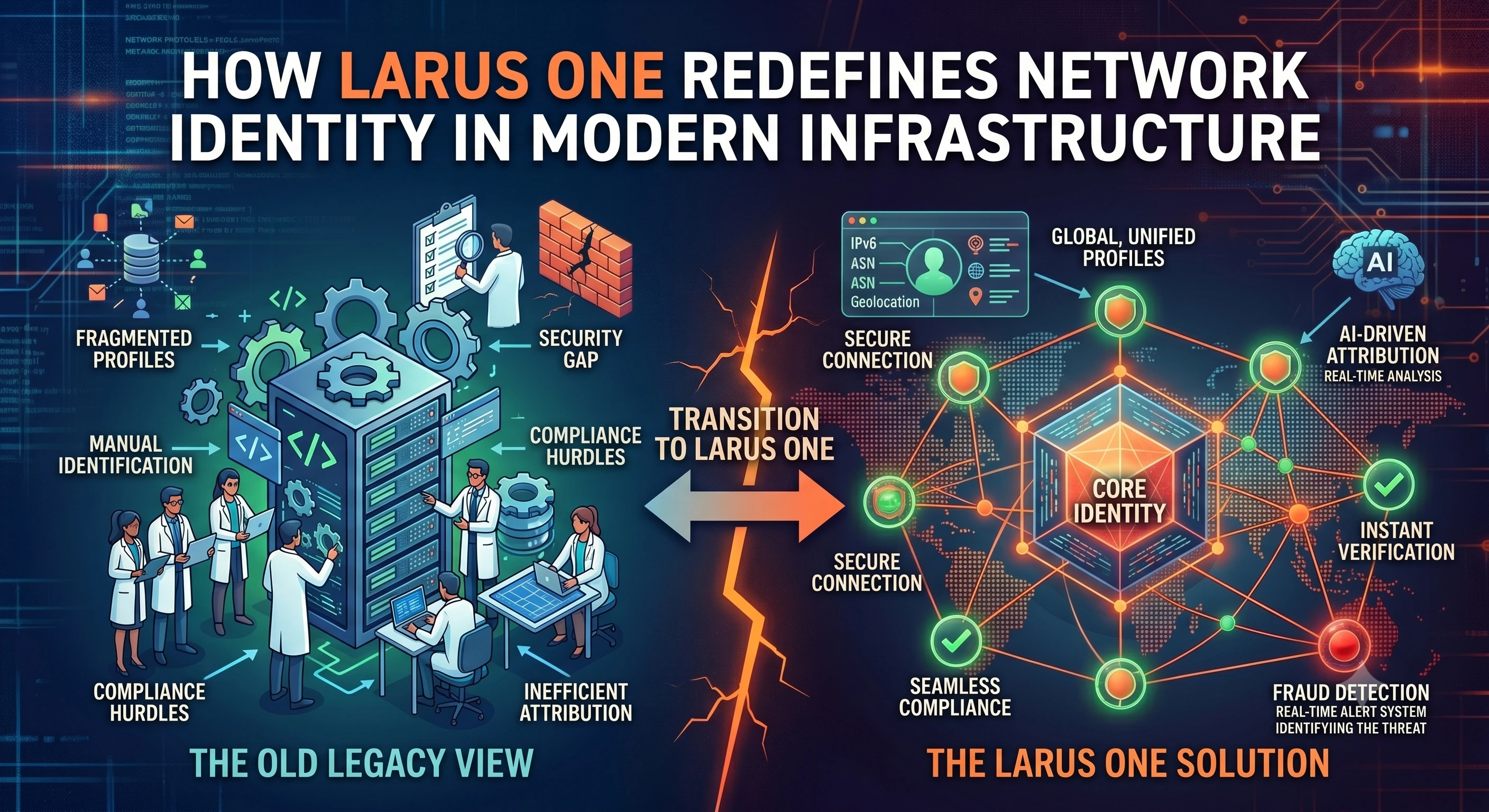

Modern infrastructure is no longer constrained by a single data center, cloud provider, or static network boundary. Businesses operate across hybrid environments where workloads move, services scale dynamically, and connectivity depends on distributed systems that were never designed to remain stable over time.
In this environment, one challenge keeps resurfacing: public network identity is fragile.
IP addresses change. Cloud environments are re-provisioned. Partners and customers maintain allowlists that break during migration. Security systems rely on identifiers that were never meant to be permanent.
LARUS One addresses this problem by redefining network identity as a stable, portable, and business-aligned public identity layer—one that remains consistent even as infrastructure changes underneath it.
A New Model: Public Network Identity That Doesn’t Break
Traditional infrastructure treats IP addresses as temporary allocations. They are assigned by providers, tied to regions or networks, and frequently changed during scaling, migration, or failover events.
LARUS One takes a different approach:
Public IP identity should behave like a business asset—not a disposable resource.
Instead of constantly adapting to changing IP space, organizations can define stable public identities for the parts of their infrastructure that must remain consistently reachable and recognized.
This includes:
- Employees and privileged users
- Production servers and workloads
- APIs and partner-facing services
- Offices, clouds, and critical network edges
Each of these becomes part of a structured identity map that reflects how the business actually operates on the internet.
Identity Map: Mapping What the Internet Already Trusts
Most organizations already have a hidden identity layer spread across their infrastructure—trusted IPs embedded in:
- customer allowlists
- partner integrations
- security policies
- compliance configurations
- third-party dependencies
The problem is that this identity is implicit, fragmented, and fragile.
LARUS One formalizes this into an Identity Map.
This map helps organizations:
- Discover where their infrastructure is already recognized externally
- Identify critical IP dependencies that cannot change
- Structure stable identities around real business actors
- Prevent accidental disruption during infrastructure changes
Instead of discovering identity problems during outages or migrations, organizations design identity intentionally from the start.
Identity Surface: People, Servers, Services, Locations
LARUS One organizes network identity around four foundational elements:
1. People
Employees, administrators, and privileged users require consistent and controlled public identity for secure access to external systems and partners.
2. Servers
Production workloads and backend systems need stable identity across cloud, on-prem, and hybrid deployments.
3. Services
APIs, integrations, and partner-facing endpoints depend on persistent identity to avoid breaking customer configurations.
4. Locations
Offices, cloud regions, data centers, and edge environments form the physical structure behind enterprise connectivity.
Together, these elements create a structured public identity surface that reflects real operational dependencies—not temporary network assignments.
Continuity Layer for Infrastructure That Cannot Renumber
One of the most common operational failures in modern infrastructure is renumbering risk—the disruption caused when IPs change and external systems fail to adapt.
LARUS One introduces a continuity layer that stabilizes public identity across:
- cloud migrations
- provider changes
- region scaling events
- infrastructure modernization efforts
This continuity layer ensures that identity does not break when the underlying network changes.
Key capabilities include:
- First-party address allocation
- Structured renewal and continuity controls
- Operational management of identity lifecycles
- Support for DNS, routing, and reputation consistency
- Clear escalation paths for critical identity dependencies
The result is a public identity layer designed for long-term stability rather than short-term allocation.
Provider Independence by Design
Modern infrastructure is inherently multi-provider. Organizations use multiple clouds, ISPs, CDNs, and edge platforms to achieve resilience and performance.
However, this creates a hidden dependency: public IP identity becomes tied to providers.
When providers change, identity changes with them.
LARUS One removes this dependency by decoupling identity from infrastructure providers.
This enables:
- Cloud migration without breaking external allowlists
- Multi-cloud architectures with consistent identity
- Separation of production identity from provider-assigned addresses
- Stable connectivity across changing infrastructure vendors
In this model, identity belongs to the business—not the infrastructure provider.
Designing Identity Like an Architecture, Not an Allocation
Traditional networking treats IP space as something assigned and consumed.
LARUS One treats it as something designed.
The lifecycle looks like this:
1. Discover
Map existing dependencies across customers, partners, systems, and services.
2. Design
Define which people, servers, services, and locations require stable identity.
3. Deploy
Implement structured identity with continuity controls and operational support.
This turns network identity into a deliberate architectural layer rather than an incidental byproduct of infrastructure.
Why This Matters
As infrastructure becomes more distributed, the cost of unstable identity increases:
- Broken customer allowlists
- Failed partner integrations
- Security rule drift
- Migration downtime
- Operational rework across teams
A stable public identity layer reduces this friction by ensuring that what the outside world trusts remains consistent—even when the inside changes constantly.
Conclusion
Modern infrastructure does not fail because systems cannot scale. It fails when identity assumptions break.
LARUS One introduces a new approach: a provider-independent, continuity-driven public network identity layer that allows organizations to design identity intentionally and maintain it reliably over time.
In doing so, it reframes network identity not as a temporary assignment—but as a durable foundation for how businesses are recognized, connected, and trusted on the internet.
For a deeper economic and infrastructure perspective, see:
Note:68 On LARUS One — The Economics of Network Identity, Customer Continuity, and Provider Revenue
Frequently Asked Questions (FAQ)
1. What problem does LARUS One solve?
LARUS One addresses the instability of public network identity in modern infrastructure. It solves issues caused by changing IP addresses, cloud migrations, and fragmented allowlists by introducing a stable, structured identity layer.
2. How is LARUS One different from traditional IP management?
Traditional IP management treats addresses as temporary, provider-assigned resources. LARUS One treats public IP identity as a persistent business asset that remains consistent even when underlying infrastructure changes.
3. Does LARUS One replace cloud or ISP providers?
No. LARUS One does not replace infrastructure providers. Instead, it decouples identity from those providers, allowing organizations to operate across multiple clouds and networks without breaking external dependencies.
4. What types of systems can be included in an Identity Map?
An Identity Map can include people (users and administrators), servers (workloads and systems), services (APIs and integrations), and locations (offices, clouds, and data centers). These elements together form a structured identity surface.
5. Why is stable network identity important for modern infrastructure?
Stable identity reduces operational risk caused by renumbering, migrations, and provider changes. It prevents allowlist breakage, integration failures, and downtime, ensuring external systems can consistently trust and reach critical infrastructure.
Keep your network moving
Turn the next answer into your next network move.
Build with Unlimited IPv4 and explore LARUS Continuity for the network your customers depend on.