Table of Contents
Introduction
In today’s IPv4-constrained internet ecosystem, organizations increasingly rely on leasing or purchasing IP address space to support scaling infrastructure, cloud workloads, and global connectivity.
However, many still approach IPv4 as a traditional asset class—something to acquire through brokers and “own” permanently.
This assumption is outdated.
IPv4 is not truly owned. It is allocated under a global registry governance system, enforced by Regional Internet Registries (RIRs) and shaped by evolving policy frameworks.
This creates an often-overlooked structural vulnerability known as registry exposure—the risk that IP resources can be impacted by registry dependency, policy interpretation, transfer history, or compliance uncertainty.
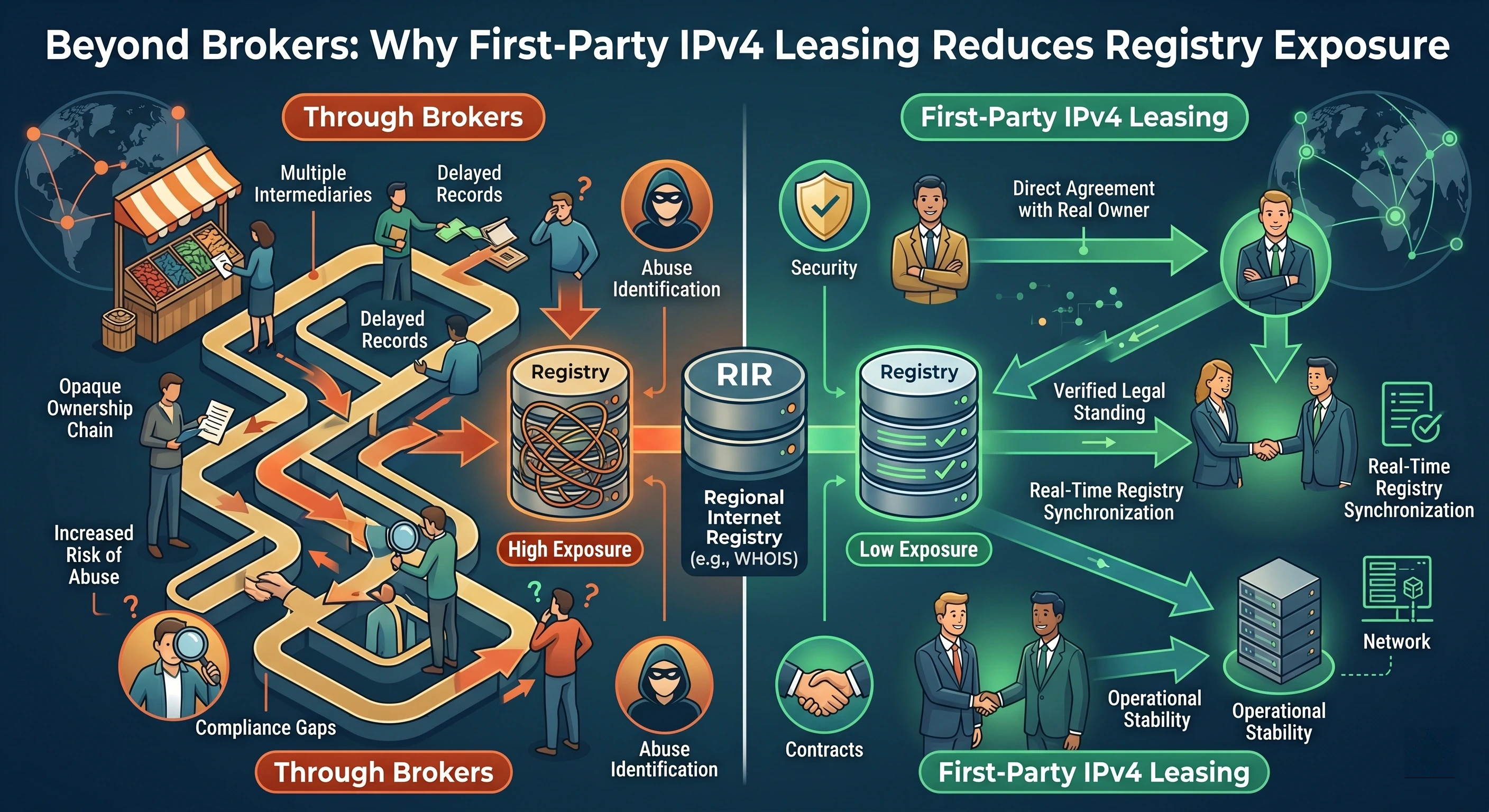
In this environment, a new model is emerging: first-party IPv4 leasing, which reduces registry exposure by removing fragmented ownership chains and centralizing lifecycle governance.
What Is Registry Exposure in IPv4 Infrastructure?
Registry exposure refers to the operational and compliance risk created when IPv4 resources depend on multiple registry-touching events and intermediaries.
These risks typically include:
-
Transfer validation delays
-
Historical ownership disputes
-
Policy reinterpretation by RIRs
-
Documentation inconsistencies
-
Revocation or audit triggers
-
Reputation inheritance issues
The more times an IP block moves through the secondary market, the more registry interactions it accumulates.
Each interaction introduces potential uncertainty.
This means the real risk in IPv4 infrastructure is not scarcity alone—it is governance fragmentation.
The Problem with Traditional IPv4 Brokers
IPv4 brokers play a role in enabling liquidity in a constrained market. They connect buyers and sellers, facilitate transfers, and help navigate registry procedures.
However, the broker model is inherently transactional, not structural.
1. Fragmented Ownership Chains
Brokered IPv4 addresses often pass through multiple entities over time. Each transfer creates a fragmented chain of custody that depends on:
-
historical accuracy of registry records
-
correct documentation from prior holders
-
successful approval from RIR policies
-
clean transfer verification processes
This fragmentation increases registry exposure over time.
2. No Lifecycle Responsibility
Once a transaction is completed, brokers typically disengage from ongoing operational management.
This creates a gap between:
-
acquisition (one-time event)
-
and operational stability (continuous requirement)
IPv4 infrastructure, however, requires long-term continuity—not one-time transactions.
3. Hidden Legacy Risk
Even when IP blocks are successfully transferred, they may carry:
-
prior abuse history
-
inconsistent usage records
-
reputation degradation
-
unclear allocation lineage
These legacy factors can trigger future registry or network-level issues, even after “clean” acquisition.
4. No Continuity Guarantee
Most importantly, brokers do not provide guarantees against:
-
registry policy changes
-
compliance reinterpretation
-
future transfer disputes
-
operational interruptions
This leaves enterprises exposed to systemic uncertainty.
Why First-Party IPv4 Leasing Changes the Model
First-party IPv4 leasing introduces a fundamentally different architecture.
Instead of treating IPv4 as a transferable asset, it treats it as a continuously managed infrastructure resource under a unified governance layer.
In this model, IP resources remain under stable allocation control, with leasing structures built on consistency rather than fragmented transfers.
How First-Party Leasing Reduces Registry Exposure
1. Minimizing Registry Touchpoints
Every registry interaction introduces potential risk:
-
approvals
-
validations
-
reassignments
-
documentation reviews
First-party leasing significantly reduces these touchpoints by keeping IP allocation within a controlled, continuous management framework.
Fewer registry events = lower exposure.
2. Eliminating Chain-of-Custody Fragmentation
Instead of multiple ownership transfers, first-party leasing maintains a single, stable allocation origin.
This eliminates:
-
unclear historical ownership chains
-
inconsistent registry records
-
transfer validation uncertainty
-
inherited compliance ambiguity
The result is a cleaner, more predictable IP lifecycle.
3. Stronger Policy Resilience
RIR policies evolve over time. What is acceptable today may be interpreted differently tomorrow.
Broker-acquired IPv4 assets often sit in “policy-sensitive zones” due to historical transfers.
First-party leasing reduces this risk by ensuring:
-
standardized allocation governance
-
consistent documentation practices
-
controlled usage environments
-
reduced dependency on legacy registry interpretations
This improves resilience against policy changes.
4. Improved Operational Continuity
For enterprises, IPv4 stability directly impacts:
-
application uptime
-
email deliverability
-
network routing consistency
-
security reputation
Registry disputes or transfer issues can lead to serious operational disruptions.
First-party leasing prioritizes continuity over ownership, ensuring that IP resources remain stable and operational without interruption from registry complexity.
5. Cleaner Reputation and Trust Profile
IPv4 reputation matters across:
-
email systems
-
CDN performance
-
firewall trust scoring
-
anti-abuse systems
Brokered IPs may carry hidden or inherited reputation risks.
First-party leasing enables:
-
controlled allocation environments
-
consistent monitoring
-
reduced exposure to legacy abuse history
-
cleaner operational reputation profiles
This improves long-term network performance and deliverability.
Why This Matters More in Today’s IPv4 Market
The IPv4 ecosystem is under increasing pressure:
-
global scarcity continues
-
secondary market prices fluctuate
-
compliance enforcement is tightening
-
enterprise reliance on IP stability is growing
In this environment, the key challenge is no longer just acquisition, but sustained operational reliability.
Traditional broker-based acquisition models were designed for a more flexible IPv4 environment.
Today, they often introduce more risk than they solve.
LARUS and the First-Party Leasing Approach
LARUS introduces a structural alternative to the brokerage model by focusing on:
-
first-party IPv4 leasing structures
-
centralized allocation governance
-
lifecycle-managed IP resources
-
continuity-first operational design
Instead of treating IPv4 as a tradable commodity, this approach treats it as a critical infrastructure layer that requires continuous stability and governance integrity.
The key difference is architectural:
-
Brokers optimize transactions
-
First-party leasing optimizes continuity
From Ownership Thinking to Continuity Thinking
The IPv4 market is undergoing a fundamental shift in mindset.
Old model:
“We need to buy and own IP addresses.”
New model:
“We need stable, compliant, continuously operational IP resources.”
Ownership creates the illusion of control, but introduces hidden registry dependencies.
Continuity removes that illusion and replaces it with real operational stability.
In a constrained IPv4 world, the most valuable outcome is not ownership—it is resilience without structural exposure.
Conclusion: Reducing Risk Through Structural Simplicity
IPv4 scarcity is not just a supply issue—it is a governance and continuity challenge.
Broker-based acquisition models will continue to exist, but they do not eliminate registry exposure. In many cases, they amplify it through fragmented ownership chains and inconsistent lifecycle control.
First-party IPv4 leasing offers a more modern approach:
-
fewer registry dependencies
-
reduced structural fragmentation
-
improved operational continuity
-
stronger compliance resilience
By simplifying the IPv4 lifecycle and centralizing governance, organizations can significantly reduce registry exposure while improving long-term infrastructure stability.
In today’s internet ecosystem, the real competitive advantage is not just access to IPv4—it is the ability to maintain uninterrupted, low-risk continuity in a constrained and heavily governed environment. Choosing the right IP address marketplace is about more than finding available IPv4 space. It is about working with a provider that can support acquisition, leasing, monetisation, and long-term network continuity. Through LARUS One Network Identity, businesses can strengthen their network identity and resource management. For flexible IPv4 access, explore LARUS Lease IPv4 Address; for organisations with unused IPv4 assets, Sell IP Addresses provides a route to turn idle resources into business value.
FAQ
What is IPv4 registry exposure?
Registry exposure refers to the risk created by dependency on Internet registry systems, policy changes, and fragmented IP ownership chains.
Why are IPv4 brokers considered risky?
Brokers facilitate transfers but do not manage long-term lifecycle, compliance, or continuity, leaving hidden structural risks.
What is first-party IPv4 leasing?
It is a model where IPv4 resources are provided under a single governance structure, reducing fragmentation and registry dependency.
Does IPv4 leasing improve stability?
Yes. By minimizing transfers and registry touchpoints, leasing improves operational continuity and reduces disruption risk.
Is IPv4 ownership still relevant?
Ownership exists in practice, but IPv4 is ultimately registry-governed. Modern infrastructure prioritizes continuity over ownership.

 Sell IPv4 Addresses
Network Partners
Blog
Insights
Knowledge Base
Support Center
Mini Speaker
Log In
Sell IPv4 Addresses
Network Partners
Blog
Insights
Knowledge Base
Support Center
Mini Speaker
Log In